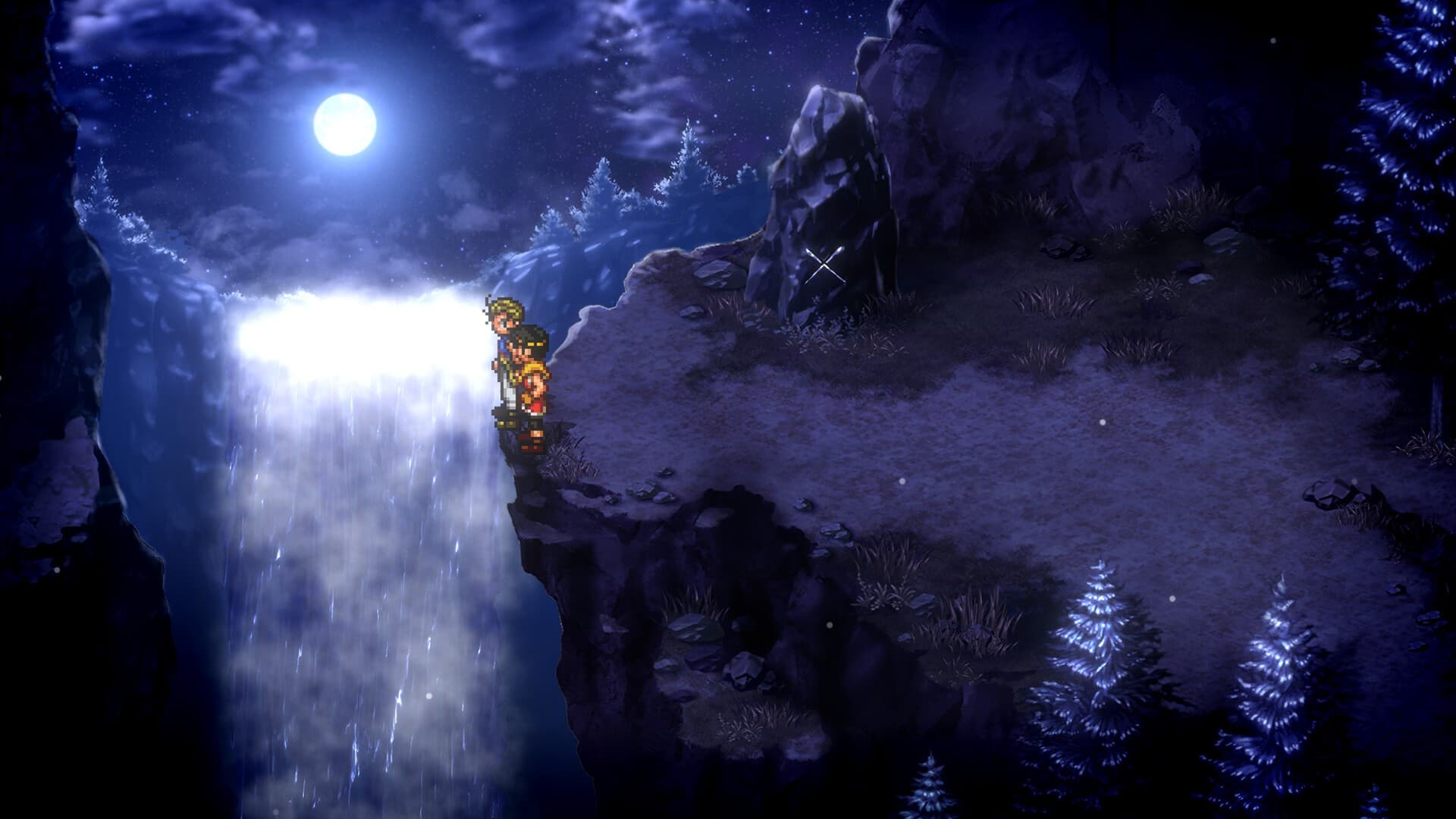
Suikoden: The Anime began airing in Japan on 3 October 2026, with a 60-minute premiere that adapts Suikoden II and a new episode every Tuesday since 13 October. Others came to the series through Suikoden I & II HD Remaster, released on 6 March 2025. Both turn on the same idea: a sign on the back of a young man's hand that will cost him everything. So the question comes up: are these real runes?
No. The runes in Suikoden are inherited crests of power, not letters. None of them stands for a sound, and the original Japanese games never call them runes at all.
Most games on this site make a rune a spell, a stone or a coin. Suikoden makes it something a person carries in their own skin: a mark on the hand or forehead that picks its bearer, stops them ageing and, at its worst, eats the people they love. That is the opposite of what a rune was for. A real rune was cut so that a stranger could read it. A True Rune is carried so that no one else can have it.
What is a rune in Suikoden?
A rune in Suikoden is the source of all magic, a sign that lives on a person's body. Each character has up to three rune slots, on the right hand, the left hand and the head, and a rune placed there grants spells or a fixed ability. Most ordinary runes are fragments of the 27 True Runes.
In play, runes come in sealed orbs. You buy an orb in a shop or find it in a chest, then take it to a rune sage who extracts the rune and sets it into a slot. In the first game that sage is Jeane, recruited at her rune shop in Antei. Weapon runes go to the blacksmith instead, and a few runes are born into a character's body and cannot be moved at all.
A magic rune gives spells by level, and a character's magic stat sets how many casts each level allows. With four level 1 casts and a Water Rune, you can cast Kindness Drops four times before you rest.
Above the shop runes sit the 27 True Runes. Eighteen are named across the series, among them the Soul Eater, the Sovereign Rune, the Gate Rune, the Rune of Beginning, the Moon Rune and the Rune of Punishment. The creation myth explains them: Darkness shed a tear, the tear became two brothers called Sword and Shield, and when they destroyed each other, "the 27 jewels that adorned Sword and Shield were turned into the 27 True Runes".
Why doesn't Japanese Suikoden call them runes?
Because the Japanese word is 紋章, monshō, and it means a crest or a coat of arms. The True Rune names are built on it: 生と死の紋章 for the Rune of Life and Death, 罰の紋章 for the Rune of Punishment, 覇王の紋章 for the Sovereign Rune. The word "rune" is the English localisation's choice.
That single word changes how the whole system reads. A crest is a heraldic sign. It works by belonging: one emblem marks one house, one bearer, one line, the way a Japanese family crest is passed down a family. A letter works by being shared. The letter F belongs to nobody, and that is why everyone can use it.
Read Suikoden with the Japanese word in mind and the design makes sense. The runes sit on the hand and the forehead, where a mark can be seen. The Sovereign Rune is a Rugner family heirloom, hidden inside the Dragon King Sword and kept as a family secret until Emperor Barbarossa revealed it. It protects him from all magic, including other True Runes. That is how a coat of arms behaves, not an alphabet.
The English word brought the mystique of the Norse futhark into a world that never had it. The Japanese word describes what the games actually show.
Why is a True Rune a curse you inherit?
Because the strongest runes pass from bearer to bearer and take a price on the way. A True Rune stops its bearer ageing and grants great power, but the Soul Eater feeds on the souls of those close to its bearer, and the Rune of Punishment drains its host's life. Each one outlives everyone who carries it.
The first game tells this as a story about one boy. Ted received the Soul Eater as a child in the Village of the Hidden Rune, when his grandfather handed it to him during an attack and told him to run. He then wandered for more than 300 years without ageing, hunted by the sorceress Windy. In Gregminster he passed the rune to his best friend, the hero, knowing what it would do to him. When Windy later turned Ted against that friend, he ordered the Soul Eater to take his own soul. His last words to the hero: "In the past 300 years, you alone were my... one true friend..."
The later games repeat the pattern:
- The Rune of Punishment (Suikoden IV) drains the life of its host. When a bearer dies, it absorbs their soul and moves on. The hero inherits it when his commander Glen Cott dies using it to save the island of Razril.
- The Rune of Beginning (Suikoden II) splits into the Bright Shield Rune and the Black Sword Rune, and their bearers are fated to fight. Genkaku and Han Cunningham carried the two halves in an earlier war. In Suikoden II they pass to Genkaku's adopted son, the hero, and his friend Jowy, who end up on opposite sides.
Real runes also passed between generations, but in the other direction. Most of the roughly 3,000 runestones in Scandinavia carry one formula: who raised the stone, who it remembers, and how they were related. "X raised this stone in memory of Y, his father." A runestone records an inheritance in public, for any passer-by to read. In Suikoden the rune is the inheritance, and it is handed over in secret. Real runes wrote down who inherited. Suikoden's runes are what gets inherited.
Does Eiyuden Chronicle use runes too?
Yes. Eiyuden Chronicle: Hundred Heroes, the spiritual successor from Rabbit & Bear Studios, was released on 23 April 2024 and directed by Suikoden's creator, Yoshitaka Murayama, who died during its development. Its magic runs on rune-lenses: runes set into a lens grant magic, abilities, stat boosts and auto-skills.
The change is telling. Runes are bought in rune shops, and the hero, Nowa, opens a new slot about every 10 levels up to level 60. The rune has moved off the skin and into a tool, and the story's Galdean Empire is building machines to amplify it. Eiyuden keeps the hundred-hero structure and the word, but its runes are no longer anyone's curse. They are equipment, and still not letters.
Suikoden runes vs. the Elder Futhark
| Feature | Suikoden (1995) | Elder Futhark |
|---|---|---|
| What one sign is | A crest of power worn on the hand or head | A letter with a sound, a name and a meaning |
| How many | 27 True Runes (18 named), plus their fragments | 24 |
| Where it sits | On the bearer's hand or forehead | Carved into wood, bone, metal and stone |
| Who can use it | One bearer at a time | Anyone who learns the letters |
| How it passes on | Hand to hand, often at a cost of life | Taught, and read by strangers |
| Can it be read? | No, nothing is encoded | Yes, once you learn the letters |
| In use | Since 15 December 1995 | Roughly 150 to 800 CE |
The real runes, briefly
The Elder Futhark is the oldest runic alphabet: 24 letters used by Germanic peoples from roughly 150 to 800 CE, cut into wood, bone, metal and stone. Each letter has a sound, a name and a meaning. Fehu is cattle and wealth, Uruz the wild ox, Ansuz a god. The alphabet takes its name from its first six letters, f, u, th, a, r, k.
The magic grew on top of the writing. In Norse tradition, Odin wins the runes by hanging nine nights on the world-tree Yggdrasil, pierced by his own spear. From there the runes served as charms and protections, were combined into bindrunes and sigils, and were read for guidance in a practice that continues today. Real runes start as shared language and gain power. Suikoden's runes start as private power and never become language.
Why a Water Margin world has no room for real runes
Suikoden is the Japanese reading of Water Margin (水滸伝), the classic Chinese novel about 108 outlaws who rise against a corrupt state. The full Japanese title, Gensō Suikoden, means "Fantasy Water Margin", and every game gathers 108 Stars of Destiny in the novel's honour.
The world borrows from that novel and from East Asian history, not from Scandinavia. There is no Odin, no Yggdrasil and no Eddas in it. The only Norse thing in the series is the English word "rune", added in translation.
Given that, an invented crest was the honest choice, and the Japanese word fits the world better than the English one. A futhark letter in Gregminster would make as little sense as a Chinese bandit in a Viking saga.
Want runes you can actually read?
Suikoden gives you 27 signs that own their bearers. The Elder Futhark gives you 24 that belong to everyone who learns them.
The easiest way in is to draw one. You can cast a free rune reading in your browser right now, using the genuine Elder Futhark and their traditional meanings, with a quick single draw for a fast question or a fuller spread for something weightier. If you would rather build the habit slowly, pull a rune of the day each morning and learn the futhark one sign at a time, or read how online rune readings work first. The rest of the series is collected on the runes in games hub.
Two other games on this site put the rune on the bearer too. In Elden Ring, the demigods hold shards of the Elden Ring called Great Runes, and you take them by killing their bearers. In Dishonored, only those with the Outsider's Mark on the back of the hand can use a rune at all.
Ted carried his rune for 300 years and could never share it. The real runes were made to be shared, and they are still waiting for anyone who wants to learn them. , free on iOS, Android, and the web, in English and Russian.
Frequently asked questions
Are the runes in Suikoden real runes?
No. The runes in Suikoden are invented signs of power that sit on a character's hand or forehead and grant magic. None of them stands for a sound, and none can be read. The original Japanese games do not even use the word rune: they call them monshō, a crest or coat of arms. Rune is the English localisation's choice of word.
What are the 27 True Runes in Suikoden?
They are the 27 original runes of the Suikoden world, and in the series they act as the equivalents of gods. The creation myth says they were the 27 jewels that adorned the brothers Sword and Shield, born from a tear of Darkness. Most ordinary runes, such as the Fire Rune or the Water Rune, are fragments of a True Rune.
How many True Runes are known in Suikoden?
Eighteen of the 27 are named across the series. The first game brings in seven, including the Soul Eater, the Sovereign Rune and the Gate Rune. Suikoden II adds the Rune of Beginning, the Beast Rune and the Moon Rune; Suikoden III the four elemental True Runes; IV the Rune of Punishment; and V the Sun Rune. The other nine are still unnamed.
What does the Soul Eater do in Suikoden?
The Soul Eater, also called the Rune of Life and Death, is the hero's True Rune in the first Suikoden. It is said to hold power over life and death and to steal the souls of those close to its bearer to grow stronger. Ted carried it for more than 300 years before passing it to his best friend, the hero.
Do True Rune bearers stop ageing in Suikoden?
Mostly, yes. A True Rune stops its bearer ageing and protects them from disease and natural death, though they can still be killed. The rule has gaps: Luc held the True Wind Rune from birth and still grew into his late teens. Ted stopped ageing while he held the Soul Eater, and grew again while he was separated from it.
What is the Japanese word for rune in Suikoden?
Monshō, written 紋章, which means a crest or a coat of arms. The True Rune names are built on it: the Rune of Life and Death is 生と死の紋章, the Rune of Punishment 罰の紋章 and the Sovereign Rune 覇王の紋章. The series word for the 27 True Runes is 27真紋章. English translators chose rune; the Japanese games describe heraldry.
How do you equip runes in Suikoden?
You take a rune orb to a rune sage, such as Jeane in Suikoden I, who sets the rune into one of a character's slots: the right hand, the left hand or the head. Most characters have fewer than three slots. Some runes are fixed to their bearer and cannot be moved, and weapon runes are attached at a blacksmith instead.
What is the Rune of Beginning in Suikoden II?
A True Rune normally split in two, the Bright Shield Rune and the Black Sword Rune. Their bearers are fated to fight. In Suikoden II the hero carries the Bright Shield Rune, which holds healing magic, and his childhood friend Jowy Atreides carries the Black Sword Rune. Using the halves can cost both bearers their lives.
What is the Rune of Punishment in Suikoden IV?
A cursed True Rune that drains the life of its host in exchange for its power. When a bearer dies, the rune absorbs their soul and passes to a new host. In Suikoden IV the hero inherits it after Glen Cott dies using it to drive off a pirate attack on Razril. It is the clearest case of a rune as a curse.
Where do the runes come from in the Suikoden lore?
From a creation myth. Darkness shed a tear, and from it came two brothers, Sword and Shield. They fought for a week and destroyed each other: Sword's pieces became the heavens, Shield's the land, and the sparks the stars. The 27 jewels that adorned them became the 27 True Runes, and every other rune descends from those.
Is Suikoden based on Norse mythology?
No. Suikoden is the Japanese reading of Water Margin, a classic Chinese novel about 108 outlaws, and the full Japanese title Gensō Suikoden means Fantasy Water Margin. Every game gathers 108 Stars of Destiny in the novel's honour. There are no Norse gods, Eddas or futhark letters in the series. The word rune is the only Norse thing in it.
Does Eiyuden Chronicle have runes like Suikoden?
Yes. Eiyuden Chronicle: Hundred Heroes, released on 23 April 2024 by Rabbit & Bear Studios and directed by Suikoden creator Yoshitaka Murayama, uses rune-lenses. Runes set into a lens grant magic, abilities and stat boosts, and the hero Nowa opens a new slot about every 10 levels. As in Suikoden, the runes are equipment for magic, not letters.
Can you read the runes in Suikoden?
No, because they encode nothing. A Suikoden rune is a single emblem that names a single power, like a family crest names a single house. There is no alphabet behind the signs and no way to combine them into words. The Elder Futhark works the other way: 24 letters that can spell any word in a Germanic language.
Where can I try a real rune reading online?
You can cast a free rune reading in your browser with the Way of the Runes rune-reading tool. It uses the genuine 24 Elder Futhark runes and their traditional meanings, with quick single draws for a fast question and fuller spreads for something weightier, and a full description for every rune. It works on any device, in English and Russian.
Which rune are you?
Seven questions, about a minute, and you get one of the 24 Elder Futhark runes. The scoring is shown as you answer. Free, no signup.