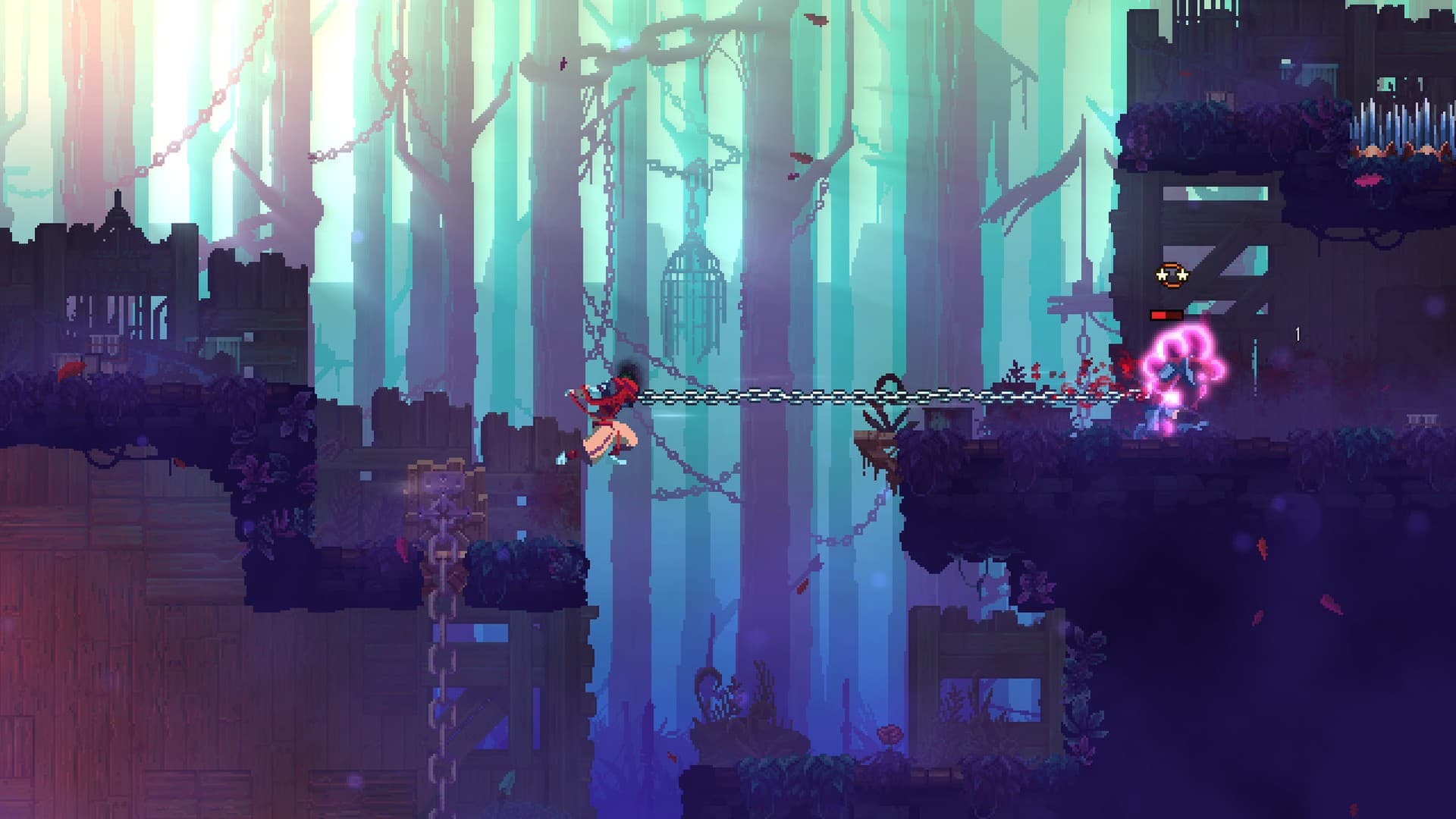
Dead Cells left early access on 7 August 2018 and had sold over 10 million copies by June 2023, and nearly every one of those players hits the same wall. A few rooms into the Promenade of the Condemned, an elite Undead Archer dies, drops a glowing tablet called the Vine Rune, and suddenly the vines you walked past twice can be climbed. So: are these real runes?
No. The runes in Dead Cells are permanent keys, not letters. There are ten of them, each teaches the Prisoner one new move, and none of them spells anything.
(If you came for the list: each rune drops from a named elite or boss, and the table below gives all ten with their biomes. Now the real question.)
Most games on this site treat runes as things you carry: Enshrouded stacks them, Gothic 2 crafts them on plates. Dead Cells does something odder. In a game where death takes back every weapon, every scroll and every unspent Cell, a rune is the one thing you never lose, because it is not an object at all. It is something the Prisoner now knows. Dead Cells gets the hardest part of runes right: they are knowledge you keep. It just teaches the wrong kind.
What is a rune in Dead Cells?
A rune in Dead Cells is a permanent unlock that an elite enemy or a boss drops. Picking it up gives the Prisoner a new ability for every future run, such as clinging to walls or using teleport monoliths. There are 10 runes: 8 in the base game and 2 in Richter Mode.
Dead Cells is a roguelite with a metroidvania map. The roguelite half resets you on death. The metroidvania half shows you places you cannot reach yet: a ledge too high, a floor with a crack in it, a wall of dead vines. The runes are the bridge between the two halves. Each one opens a class of locked spots across the whole island, and from that run on, those spots stay open.
The community wiki's rune descriptions all open with the same three words, "This permanent rune", and then say what it lets you do. The Vine Rune "causes climbing vines to grow". The Spider Rune "lets you cling to walls". The Homunculus Rune "lets you leave your body". These are verbs. Not one of them is a sound.
Where do you find all 10 runes in Dead Cells?
Each rune drops from one named elite or boss in one biome, and you keep it from the moment you pick it up. The Vine Rune from the Promenade comes first; the Homunculus Rune from the Hand of the King comes last. Richter Mode's two runes sit on pedestals instead.
| Rune | Where | Dropped by | What it opens |
|---|---|---|---|
| Vine Rune | Promenade of the Condemned | Undead Archer (elite) | Climbing vines; the Toxic Sewers |
| Customization Rune | Ramparts | Undead Archer or Zombie (elite) | Custom Mode |
| Challenger's Rune | Black Bridge | The Concierge (boss) | The daily challenge run |
| Teleportation Rune | Toxic Sewers | Slasher (elite) | Teleport monoliths in many biomes |
| Ram Rune | Ossuary | Slasher (elite) | Breakable floors; the Ancient Sewers |
| Explorer's Rune | Forgotten Sepulcher | Two Dark Trackers | Reveals the map and its points of interest |
| Spider Rune | Slumbering Sanctuary | Caster (elite) | Wall clinging; Prison Depths and more |
| Homunculus Rune | Throne Room | Hand of the King (boss) | A detachable head; the Cavern |
| Dodge | Richter Mode | A pedestal near the start | Richter's airborne dodge |
| High Jump | Richter Mode | A pedestal on the right of the map | Richter's high jump |
One name in that list gives away where the game was made. The Ram Rune was first called Belier's Rune. Motion Twin is a studio in Bordeaux, and bélier is French for a ram, and for a battering ram. The rune smashes you down through cracked floors, so the name was a pun on the job, not a person.
Why are runes the only thing you keep when you die?
Because Dead Cells is built on loss. When the Prisoner dies, every weapon, scroll and unspent Cell is gone, and the island reshuffles. Runes survive because they are not items in your pocket but abilities in your body. They even skip the Collector: a rune unlocks the instant you touch it.
That design is clever, and it brushes against something true. A real rune was never really the stick or the stone it was cut on. Those rotted, broke or were lost; most runic writing on wood has not survived at all. What survived the carver was knowing how to cut it and how to read it. The Hávamál, the Old Norse poem of Odin's sayings, asks it as a test: "Do you know how to carve? Do you know how to read?"
So both kinds of rune are knowledge you carry from one life into the next. The difference is what the knowledge does. The Prisoner learns that cracked floors break. A carver learned that ᚠ is the sound f, and could then write any word that had an f in it.
Did the word "rune" once mean a secret?
Yes. The word goes back to a reconstructed Proto-Germanic form, rūnō, meaning a secret or a secret conversation. Gothic rūna meant secret, mystery or counsel, and Old English rūn meant a whisper. The sense of "letter" came later, attached to the alphabet people learned in private.
That oldest meaning fits Dead Cells better than it fits most games. Every rune here opens a hidden way: a vine that was not climbable, a floor that was not breakable, a teleporter that would not answer. The island keeps its secrets until you hold the right rune, and then it shows them all at once, in every biome.
Real runes went the other way. Once the secret was learned it was shared. Memorial stones were raised by roads and fords where the most people would pass, and were usually painted when new. Bloodborne keeps the word's darker half, runes as voices no human can say. Dead Cells keeps the brighter half: a secret that, once you have it, opens doors.
Dead Cells runes vs. the Elder Futhark
A Dead Cells rune and an Elder Futhark rune share one thing: you learn each once and keep it. Everything else differs. One is an ability that opens a map; the other is a letter that writes a language. The table sets the ten keys beside the 24 letters.
| Feature | Dead Cells (2018) | Elder Futhark |
|---|---|---|
| What one sign is | A permanent ability, such as wall clinging | A letter with a sound, a name and a meaning |
| How many | 10 (8 base, 2 in Richter Mode) | 24 |
| How you get it | Kill the elite that carries it | Learn it from someone who can write |
| What it opens | Paths, modes and map areas | Any word in the language |
| Combines with others? | No, each works alone | Yes, letters combine into words |
| Can it be read? | No, nothing is encoded | Yes, once you learn the letters |
| Lost at death? | Never | Only if no one passes it on |
| In use | Since 10 May 2017 (early access) | Roughly 150 to 800 CE |
The real runes, briefly
The Elder Futhark is the oldest runic alphabet: 24 letters in three rows of eight, carved by Germanic peoples from roughly 150 to 800 CE on wood, bone, metal and stone. Each letter is a sound with a name, and the name is a word: Fehu is cattle and wealth, Uruz the wild ox, Ansuz a god.
In the Viking Age it shrank to the 16-letter Younger Futhark, and runic writing in Scandinavia lasted for centuries after that. The magic was layered on top of the writing. In Norse tradition Odin wins the runes by hanging nine nights on Yggdrasil, and from there they served as charms and protections, were combined into bindrunes and sigils, and were read for guidance in a practice that continues today.
Why the island has no room for real runes
Dead Cells is set on an unnamed island ruled by a reclusive King and eaten by a plague called the Malaise. The Steam page calls the Prisoner "a failed alchemic experiment". Its world is prisons, sewers, ramparts and laboratories, with no Norse gods, no Yggdrasil and no Eddas.
In that world a borrowed Germanic alphabet would have had nothing to do. The island has no language you are asked to read; it speaks through architecture, and the runes are keys to that architecture. When Motion Twin and Evil Empire did borrow a mythology, with Return to Castlevania on 6 March 2023, they borrowed Konami's Dracula, not Scandinavia.
The set is now closed. Creative work stopped with The End is Near update on 19 August 2024, so the island will never hold more than ten runes. The futhark has held 24 for far longer.
Want runes you can actually read?
Dead Cells gives you ten runes that teach your body new moves and survive every death. The Elder Futhark gives you 24 that teach your eye a sound, and they have survived nearly two thousand years.
The easiest way in is to draw one. You can cast a free rune reading in your browser right now, using the genuine Elder Futhark and their traditional meanings, with a quick single draw for a fast question or a fuller spread for something weightier. If you would rather build the habit slowly, pull a rune of the day each morning and learn the futhark one sign at a time, or read how online rune readings work first. The rest of the series is on the runes in games hub, including Zelda: Breath of the Wild, where a rune is also a new ability, and Valheim, the one game that uses the real futhark.
No elite to kill and no Cells to lose. , free on iOS, Android, and the web, in English and Russian.
Frequently asked questions
Are the runes in Dead Cells real runes?
No. A rune in Dead Cells is a permanent unlock that an elite enemy or a boss drops. Picking it up teaches the Prisoner something new, such as growing vines, clinging to walls or breaking floors. No rune carries a letter, a sound or a name from any runic alphabet, and nothing on the island is written in the Elder Futhark.
How many runes are in Dead Cells?
Ten. Eight belong to the base game: the Vine, Teleportation, Ram, Spider, Homunculus, Explorer's, Customization and Challenger's runes. Two more, which teach a dodge and a high jump, sit on pedestals in Richter Mode, added with the Return to Castlevania DLC in March 2023. The Elder Futhark has 24 letters, so the island's set is less than half its size.
How do you get runes in Dead Cells?
Kill the elite enemy that guards each one, and the rune drops when it dies. The Vine Rune comes from an Undead Archer in the Promenade of the Condemned, the Teleportation Rune from a Slasher in the Toxic Sewers and the Spider Rune from a Caster in the Slumbering Sanctuary. Two bosses give runes too: the Concierge and the Hand of the King.
Do you keep runes when you die in Dead Cells?
Yes. Runes are permanent and survive every death, which makes them rare in a game that takes almost everything back. When the Prisoner dies, weapons, scrolls and unspent Cells are lost. A rune unlocks the moment you touch it, with no trip to the Collector needed, and every rune you own is listed on your save slot.
What is the first rune to get in Dead Cells?
The Vine Rune, from an elite Undead Archer in the Promenade of the Condemned. The community wiki notes that without it you cannot continue through that biome, so every player meets it early. It makes climbing vines grow at marked spots, which opens the way to the Toxic Sewers from the Prisoners' Quarters and to new rooms on the Promenade.
What does the Homunculus Rune do in Dead Cells?
It lets the Prisoner leave his body. His head detaches, flies at an enemy, latches on and can pull pickups back, and it climbs walls without limit. The Hand of the King grants it automatically when you defeat him in the Throne Room. It also opens the Cavern from the Rise of the Giant update. It cannot be used while cursed.
Why was the Ram Rune called Belier's Rune?
Because Motion Twin is a French studio, based in Bordeaux, and bélier is the French word for a ram, and also for a battering ram. The early English name kept the French word. The rune lets the Prisoner smash down through certain floors, which is exactly a battering ram's job, and it opens the Ancient Sewers from the Toxic Sewers.
Can you read the runes in Dead Cells?
No, because they are not writing. A Dead Cells rune is an ability with an icon, not a character in a script. It has no letter value and no place in an alphabet, so there is no cipher to break. The game never builds a word out of runes, and it never asks the player to read one. In this series only Valheim uses the real futhark.
Is Dead Cells based on Norse mythology?
No. Dead Cells is set on an unnamed island ruled by a reclusive King and ravaged by a plague called the Malaise. You play the Prisoner, a mass of cells that takes over a body, in a world of prisons, sewers, castles and alchemy. There are no Norse gods, no Yggdrasil and no Eddas. The later DLC borrowed Castlevania, not Scandinavia.
What did the word rune originally mean?
A secret. The word goes back to a reconstructed Proto-Germanic form, rūnō, meaning a secret or a secret conversation. Gothic rūna meant secret, mystery or counsel, and Old English rūn meant a whisper or a secret. Only later did it settle on the letters of the runic alphabets. Dead Cells uses it for hidden paths, which fits that oldest sense.
Are Dead Cells runes like the runes in Zelda: Breath of the Wild?
Yes, closely. In both games a rune is a new ability rather than a sign: Link's Sheikah Slate learns Magnesis and Stasis at pedestals, and the Prisoner learns to cling to walls or teleport. Both are keys to places the world has already shown you. Neither is an alphabet. The Richter Mode runes even sit on pedestals, as Link's do.
Is Dead Cells still being updated?
No new content is coming. Motion Twin and Evil Empire stopped creative work on Dead Cells with The End is Near update on 19 August 2024, which reached iOS and Android on 18 February 2025. They said they would keep fixing bugs. The ten runes are therefore a closed set, as the 24 letters of the Elder Futhark have been for twelve centuries.
What is the difference between Dead Cells runes and real runes?
A Dead Cells rune teaches the body a move: grow a vine, cling to a wall, break a floor. A real Elder Futhark rune teaches the eye a sound. Each of the 24 has a shape, a sound and a name, such as Fehu for cattle and wealth, and together they spell any word. Both are knowledge you keep, but only one can be read.
Where can I try a real rune reading online?
You can cast a free rune reading in your browser with the Way of the Runes rune-reading tool. It uses the genuine 24 Elder Futhark runes and their traditional meanings, with quick single draws for a fast question and fuller spreads for something weightier, and a full description for every rune. It works on any device, in English and Russian.
Which rune are you?
Seven questions, about a minute, and you get one of the 24 Elder Futhark runes. The scoring is shown as you answer. Free, no signup.