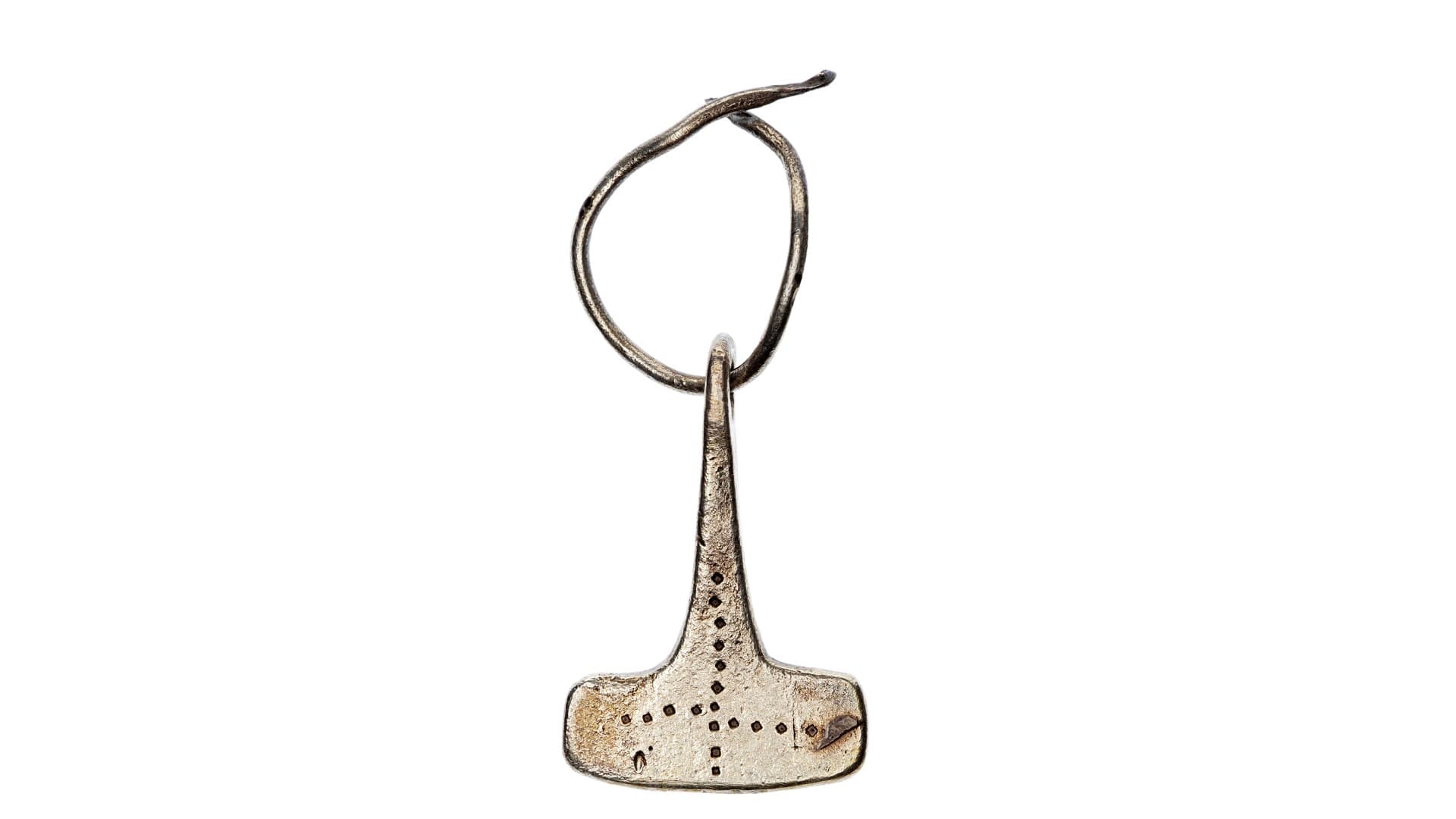
Mjolnir, the hammer of the thunder god Thor, hangs on more necks today than any other Norse sign. It is on pendants, rings, tattoos, film posters and, since 2013, on United States military headstones. Most popular Norse symbols fall apart when you ask where they come from. So the fair question is whether this one is really Viking.
Yes. Mjolnir is genuinely Viking: about 1,000 hammer pendants survive from the Viking Age, and one of them names itself in runes. It is the best documented Norse symbol there is.
That makes it the opposite of the Vegvisir, a stave first recorded in 1860, and of the berserker symbol, which has no source at all. It even beats the Valknut, whose shape is old but whose name is modern. Here we have the object, the god's name and the Vikings' own word for it. Mjolnir is the one Norse symbol the Vikings captioned for us, in runes.
What is Mjolnir?
Mjolnir (Old Norse Mjǫllnir) is the hammer of Thor, the Norse god of thunder. In the myths it kills giants, returns to his hand and hallows brides, goats and the dead. In the Viking Age people wore small copies of it as pendants. Today it is the main emblem of modern Norse paganism and the best attested Norse symbol.
The myth of its making is told in the Prose Edda, written by Snorri Sturluson around 1220. Loki bets his head that the dwarf brothers Eitri (or Sindri) and Brokkr cannot make better treasures than the sons of Ivaldi. While they forge the hammer, Loki, as a fly, bites Brokkr on the eyelid, and the handle comes out short. It is the one flaw of a weapon that never misses and always comes back.
Is Thor's hammer really Viking?
Yes. The National Museum of Denmark counts about 1,000 hammer-shaped amulets from Scandinavia, Britain, Russia and the Baltic, made of iron, silver or bronze. About 100 are richly decorated. The same shape stands on runestones of the 900s and 1000s. No other popular Norse symbol has that many finds behind it.
Five finds carry most of the case:
| Find | Date | What it shows |
|---|---|---|
| Kobelev pendant, Lolland, Denmark | 900s | A 2.5 cm bronze hammer inscribed in runes: this is a hammer |
| Laeborg runestone (DR 26), Denmark | About 900 to 950 | A hammer carved after each line of the text |
| Hilde ring, Stryn, Norway | 900s | An iron ring with nine small hammers, from a woman's cremation grave |
| Bredsatra pendant, Oland, Sweden | Viking Age | A 4.6 cm hammer of gilded silver |
| Altuna runestone (U 1161), Sweden | 1000s | Thor in a boat, fishing for the world serpent |
The rings came first. Iron rings hung with little amulets, many of them hammers, are found in cremation urns around Lake Malaren, on Aland and in Russia. The earliest belong to the Vendel Period, before the Viking Age began in about 793, and they become commoner towards its end. The single pendants on a cord belong to the Viking Age proper.
The Laeborg stone is 2.36 metres of granite near Vejen in Jutland. A man called Tofi raised it for Thyre, his lady, and after each of its two lines of runes he cut a hammer. The Altuna stone in Uppland, found in a chapel wall in 1918, shows Thor with his foot pushed through the bottom of the boat, hauling up the serpent.
The hammer that says what it is
The hook of this symbol is not a picture but a sentence. In spring 2014 a metal detectorist found a 2.5 centimetre bronze hammer at Kobelev on the Danish island of Lolland. It dates from the 900s. On one side of its head, in runes only 3 to 7 millimetres high, it carries a short text.
Runologist Lisbeth Imer of the National Museum of Denmark read it under a microscope as hmar is, with a word divider: this is a hammer. The carver left out a vowel and cut the s-rune backwards, so this was no master. It is still the only hammer amulet of the roughly 1,000 known to carry runes, and it settles a question archaeologists could only argue before: these little T-shapes really are hammers.
Runestones make the same link from the other side. On Danish and Swedish stones of the 900s and early 1000s, Thor is the only god asked to hallow the stone (a few scholars read Odin's name on one or two others), and always for the same job:
- The Glavendrup stone on Funen, the longest runic inscription in Denmark, ends: Thor hallow these runes.
- The Virring and Sonder Kirkeby stones in Denmark ask the same of Thor.
- The Velanda stone in Vastergotland, Sweden, says simply Thor hallow.
The hammer is the tool of that hallowing. The Vikings who carved runes asked Thor to protect them, and the hammer was his sign.
What does Thor's hammer mean?
The sources give Mjolnir two meanings: protection and hallowing. It is the weapon that keeps giants out of the world of gods and people, and the tool Thor uses to bless. In the myths it blesses a marriage, brings his goats back to life and hallows the funeral of Baldr. The pendants almost certainly carried the same powers.
Each of those scenes has a source:
- The bride. In the poem Thrymskvida the giant Thrym steals the hammer and demands the goddess Freyja. Thor comes dressed as the bride, and the giants bring out Mjolnir to hallow her by laying it in her lap. Thor seizes it and kills the wedding party. The poem survives in the Codex Regius of about 1270; scholars dispute whether it is Viking Age or a 13th century parody.
- The goats. In Snorri's Prose Edda Thor slaughters his goats Tanngrisnir and Tanngnjostr for supper and raises them the next morning by hallowing the bones and skins with the hammer.
- The dead. At Baldr's funeral Thor hallows the pyre with Mjolnir.
The finds agree. The National Museum of Denmark notes that hammer pendants are often found in women's graves and were protective amulets for anyone, whatever their gender. Only about one pendant in ten comes from a grave at all; the rest turn up outside graves, lost or put away by the living.
Where does the name Mjolnir come from?
Nobody knows for certain. Scholars offer three explanations, and all three suit a thunder god. The name may come from Old Norse mala, to grind, and mean the grinder or crusher. It may come from mjoll, fresh snow, and mean the shining one. Or it may be related to Russian molniya and Old Church Slavonic words for lightning.
The third reading is why Russian speakers often hear the name before they read it: Mjolnir and molniya sound close. That link is a proposal, not a proven fact, but if it holds, Thor's hammer is literally the lightning. English spellings vary for a simpler reason: the Old Norse letters ǫ and double l are awkward to type, so you will see Mjolnir, Mjollnir and Mjölnir for the same word.
Hammer or cross?
The hammer pendants became common in the 900s, the same century Christian cross pendants spread in Scandinavia. Many scholars see the hammer as the pagan answer to the cross: a sign of the old god, worn in the same way and in the same place, at the moment the old religion was being challenged.
The clearest evidence is a soapstone mould from Trendgarden in North Jutland, of the late 10th century and now in the National Museum of Denmark. It has hollows for two crosses and one hammer, so a single smith could cast both in one pour. Some later pendants are so cross-like that their owners may have meant them to pass as either.
Read that way, the mould is a snapshot of a country changing its religion: one workshop selling to both sides, and perhaps to customers who wanted both. The Laeborg stone, with a hammer where a Christian stone would carve a cross, belongs to the same moment.
Mjolnir today: pendants, tattoos and misuse
A Mjolnir pendant or tattoo is historically sound. Most people who wear one mean protection, strength, Thor or Norse heritage, and for modern Heathens it is the sign of their faith. In May 2013 the US Department of Veterans Affairs added the Hammer of Thor to its approved emblems of belief for headstones, number 55 on the list.
| What is said | What the sources show |
|---|---|
| "The Vikings wore Thor's hammer" | About 1,000 pendants survive |
| "It stands for protection" | It keeps out giants and hallows in the myths |
| "Only warriors wore it" | Pendants are often found in women's graves |
| "Mjolnir means lightning" | One of three possible etymologies |
| "The hammer had a long handle" | The Prose Edda says its handle was short |
| "It is a hate symbol" | Only in some modern hands; context decides |
The one real caution is modern. The Anti-Defamation League lists Thor's hammer because some neo-Nazis and racist Odinists use it. The same entry says most Asatruar are not racist, that the hammer is an important symbol for non-racist Norse pagans, and that it should never be read as racist on its own. Worn plainly, it is a Viking Age sign, and the evidence is on your side.
The Norse symbols hub compares the hammer with the other signs, and our guide to Norse paganism covers the faith that wears it today. If you came here from a game, the runes in games series checks which game runes are real.
Want signs you can actually read?
The Kobelev hammer shows what the Vikings did with a symbol when they wanted it understood: they wrote on it. The runes on that pendant are ordinary Viking Age letters, and the 24 runes of the Elder Futhark before them each carry a sound, a name and a meaning. You can learn to read them, and to combine them into bindrunes and sigils with a clear intent.
The easiest way in is to draw one. You can cast a free rune reading in your browser right now, using the genuine Elder Futhark and their traditional meanings. If you would rather go slowly, pull a rune of the day each morning, or read how online rune readings work first.
Wear the hammer for what it is, the sign the Vikings themselves labelled. For letters that answer back, , free on iOS, Android, and the web, in English and Russian.
Cover photo: a silver Thor's hammer pendant in the Swedish History Museum, Stockholm (object 1323121_HST). Photo by Ola Myrin, National Historical Museums of Sweden, CC BY 4.0.
Frequently asked questions
Is Mjolnir a real Viking symbol?
Yes. About 1,000 hammer-shaped pendants of iron, silver and bronze are known from Viking Age sites in Scandinavia, Britain, northern Germany, the Baltic and Russia. Danish runestones of the 900s carry the hammer beside their text, and one 10th century pendant from Kobelev on Lolland is inscribed in runes: this is a hammer. Few Norse symbols have better evidence.
What does Thor's hammer mean?
In the myths Mjolnir does two jobs. It kills giants, and it hallows: Thor blesses a bride, his resurrected goats and Baldr's funeral pyre with it. The pendants were most likely worn for protection and for Thor's blessing. Runestones asked Thor, and no other god, to hallow the runes or the memorial. Protection and blessing are the meanings the sources support.
What does the name Mjolnir mean?
Nobody knows for certain, and scholars give three readings. One ties it to Old Norse mala, to grind, so the grinder or crusher. One ties it to mjoll, fresh snow, and so to something shining white. The third compares Russian molniya and Old Church Slavonic words for lightning, making it the lightning weapon. All three fit a thunder god.
Who made Mjolnir?
In the Prose Edda, written by Snorri Sturluson around 1220, two dwarf brothers, Eitri (or Sindri) and Brokkr, forge it after Loki bets his head that they cannot outdo the sons of Ivaldi. Loki, as a fly, bites Brokkr while he works the bellows. That is why the handle came out short, the one flaw of a hammer that never misses.
What is the oldest Thor's hammer?
Iron rings hung with small hammer amulets go back to the Vendel Period, before the Viking Age began in about 793. The pendants belong to the Viking Age itself. Securely dated examples of the hammer as a sign come from the 900s: the Laeborg runestone of about 900 to 950, the Kobelev pendant and the ring with nine hammers from Hilde in Norway.
What is the Kobelev hammer?
A 2.5 centimetre bronze Thor's hammer pendant of the 900s, found by a metal detectorist at Kobelev on Lolland, Denmark, in 2014. It is the only known hammer amulet with runes. Runologist Lisbeth Imer of the National Museum of Denmark read them as hmar is, this is a hammer. The carver dropped a vowel and cut the s-rune backwards.
Why did Vikings wear Thor's hammer pendants?
Most likely for protection and blessing, the two powers the myths give the hammer. The pendants are often found in women's graves, and the National Museum of Denmark describes them as protective amulets worn regardless of gender. Some scholars also see their spread in the 900s as an answer to the Christian cross pendants appearing at the same time.
Is Thor's hammer a response to the Christian cross?
Partly, according to many scholars. Hammer pendants became more common in the 900s, just as cross pendants spread in Scandinavia, and some hammers are shaped much like crosses. A 10th century soapstone mould from Trendgarden in Denmark could cast two crosses and a hammer at the same time, so one smith served customers of both faiths.
Was Mjolnir used at weddings?
In the poem Thrymskvida it is. The giant Thrym steals the hammer, Thor comes disguised as the bride Freyja, and the giants bring out Mjolnir to hallow the bride by laying it in her lap. Thor grabs it and kills them. The poem survives in the Codex Regius of about 1270, and its date of composition is disputed.
What does a Mjolnir tattoo mean?
For most people it means protection, strength, Thor himself or Norse heritage, and modern Heathens wear the hammer as the sign of their faith. That reading matches the Viking Age evidence better than most Norse tattoos can. Because some extremists also use the hammer, a Mjolnir tattoo can occasionally be misread, so it helps to know its real history.
Is Thor's hammer a hate symbol?
Not by itself. The Anti-Defamation League lists it because some white supremacists use it, but it says most Asatruar are not racist, that the hammer is an important symbol for non-racist Norse pagans, and that it should be judged by the context in which it appears. In 2013 the US Department of Veterans Affairs approved it as a headstone emblem.
Is Mjolnir a rune?
No. Mjolnir is a picture of an object, not a letter, and it cannot be read aloud. The runes are the 24 letters of the Elder Futhark and the 16 of the Younger Futhark used in the Viking Age. The two meet on objects: the Kobelev pendant carries runes, and the Laeborg runestone sets the hammer beside its runic text.
Where can I try a real rune reading online?
You can cast a free rune reading in your browser with the Way of the Runes rune-reading tool. It uses the genuine 24 Elder Futhark runes and their traditional meanings, with quick single draws for a fast question and fuller spreads for something weightier, and a full description for every rune. It works on any device, in English and Russian.
Which rune are you?
Seven questions, about a minute, and you get one of the 24 Elder Futhark runes. The scoring is shown as you answer. Free, no signup.