The Valknut is three triangles locked together, and it is everywhere: pendants, rings, forearms, metal album covers, Heathen altars. It is sold as the knot of the slain, the mark of Odin's chosen dead. Russian searchers even ask why you must not wear it. At some point anyone who likes it asks whether any of this is real.
Yes. The Valknut shape is genuinely early medieval: it is carved on Gotland picture stones of around 700 CE and on a Viking bed of 834. What is not old is everything said about it.
That makes the Valknut the reverse of the Vegvisir, whose shape is 19th century Icelandic and whose Viking story is invented. Here the object is real, and the name, the meaning and the rules on top of it are recent. The sign is over a thousand years old; its name is modern.
What is the Valknut?
The Valknut is a figure of three interlocked triangles, drawn either as three separate triangles or as one continuous line, with nine points in all. It appears on Viking Age and slightly older objects from Gotland, Norway and England, usually beside scenes of death. Its original name and meaning are unknown; the word valknut is modern.
It is a picture, not a letter. The Valknut is not one of the 24 runes of the Elder Futhark, and it does not spell anything. On the stones where it appears it sits inside the scene, among riders, ships and birds, the way a halo or a cross sits in a later Christian picture.
Two drawings share the name today. The unicursal form, one line looping three times, is the one on the Tangelgarda stone. The Borromean form is three separate triangles where no two are linked but all three hold together; three interlaced triangles are what the Nene River ring shows.
Is the Valknut really Viking?
Yes, the shape is. It is carved on at least two picture stones from Larbro parish on Gotland, Sweden, of around the 8th century, on a bed post from the Oseberg ship burial in Norway, dated by its timbers to 834, and on a gold ring from England of about 700 to 900. Those finds place it in the Viking Age and just before it.
Here are the four finds that carry the whole case:
| Find | Date | What it shows |
|---|---|---|
| Stora Hammars I, Gotland | About 8th century | A man about to be hanged from a tree, a figure with a spear, a bird, and the valknut above an altar |
| Tangelgarda I, Gotland | Disputed: 400 to 550, or the 700s to 1000s | A rider welcomed by men raising rings, with two valknut shapes by the horse |
| Oseberg bed post, Norway | Burial of 834 | The shape cut into a carved post of a bed |
| Nene River ring, England | About 700 to 900 | Three interlaced triangles on one of two gold bezels |
Stora Hammars I now stands at the Bunge open-air museum in Farosund on Gotland. It carries six panels, and in the sacrifice panel the valknut floats above the altar where a man is about to be hanged. Tangelgarda I, found in the 1860s, is in the Swedish History Museum in Stockholm. Its rider scene is often read as a dead man welcomed into Valhalla.
The Oseberg ship grave near Tonsberg held two women, a ship and a household of goods, and was excavated in 1904. The valknut on one of its bed posts puts the sign inside a real Norwegian burial of 834.
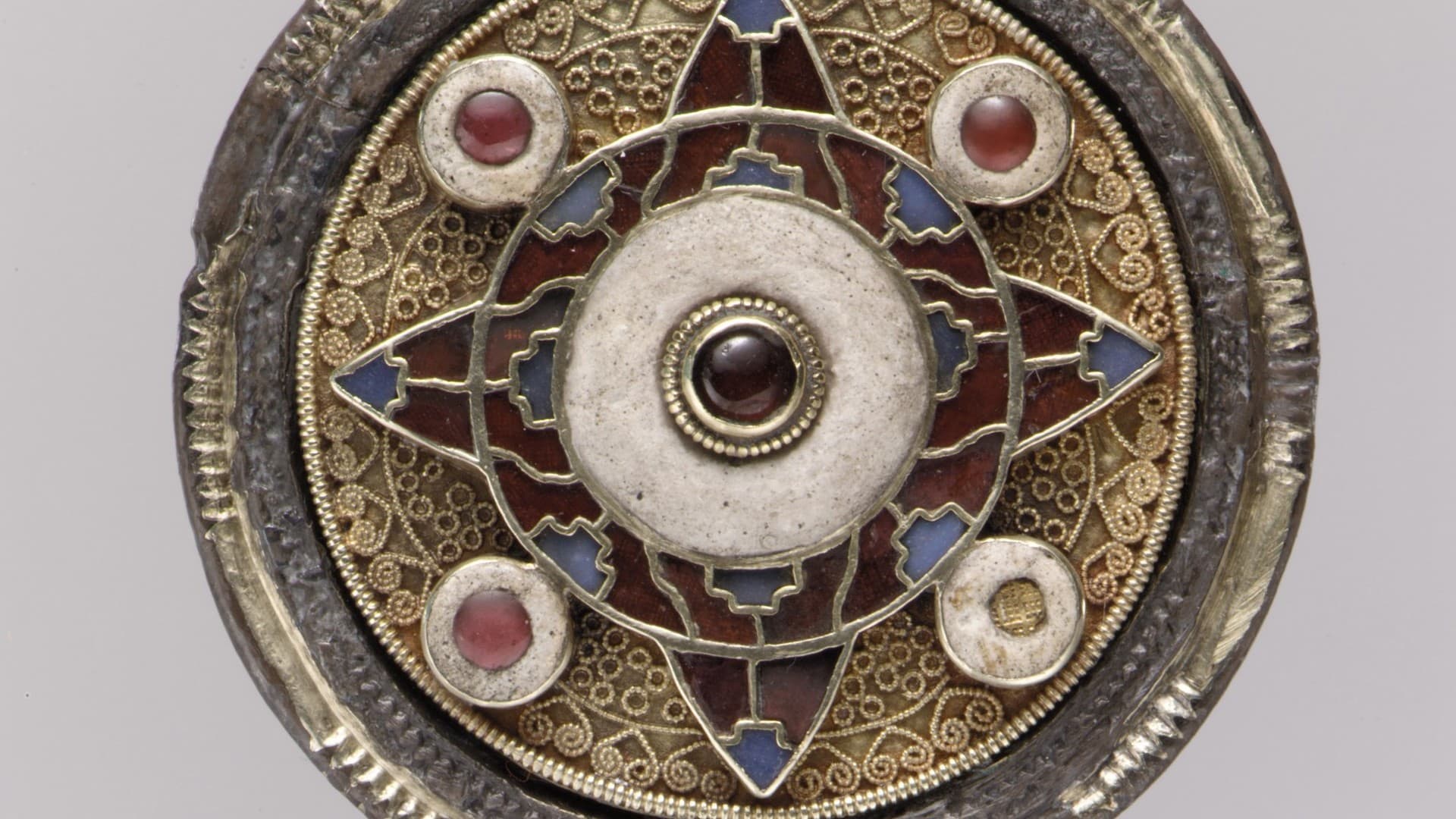
The Nene River ring was found by a man spearing eels in the River Nene near Peterborough, and the British Museum acquired it in 1855. It is Anglo-Saxon work, not Viking, but it shows the sign travelled across the North Sea world. The historian Hilda Ellis Davidson also noted similar signs on Anglo-Saxon cremation urns from East Anglia.
What does the Valknut mean?
Nobody knows, because no text from the period explains it. What the stones show is context: the sign keeps company with death, sacrifice, a spear-bearing figure and a rider arriving somewhere. From that, most scholars link it to Odin and to the dead. It is an inference from pictures, not a recorded meaning.
Two readings are cited most often:
- Hilda Ellis Davidson, in Gods and Myths of Northern Europe, read the sign beside Odin's rider on the memorial stones as the god's power to bind and unbind, which she tied to his hold over the minds of warriors in battle.
- Rudolf Simek, in his Dictionary of Northern Mythology, is more careful: the sign's company of Odin and grave goods points to religious practice around death, and no further.
A third link is often quoted and is weaker than it sounds. In the Prose Edda, written by Snorri Sturluson around 1220, the giant Hrungnir, killed by Thor, has a heart of hard stone with three sharp corners, like a carved sign that people call hrungnishjarta, Hrungnir's heart. So a three-cornered carved sign did have a name in 13th century Iceland. Snorri gives no drawing, though, and nothing ties that sign to Odin or to these stones.
Where does the name valknut come from?
The name valknut is modern Norwegian, not Old Norse. It is usually glossed as knot of the slain, from valr, the fallen on a battlefield, and knutr, knot. No saga, Edda, law code or runic inscription uses the word. Scholars applied it to the Gotland triangles in the modern era, and the popular meaning grew from the name.
There is a twist. In Norwegian folk art, valknute already named a different design: a square knot with a loop at each corner, the sign ⌘ that sits on the Apple command key. The researcher behind the blog Brute Norse argues that the val- in it may mean something rounded rather than the slain. If so, the knot of the slain rests on a translation of a name borrowed from another figure.
None of this makes the shape less old. It does mean that the most repeated sentence about it, that the Vikings called it the knot of the slain, has no source at all.
Why do people say you should not wear the Valknut?
The warnings come from modern esoteric websites and amulet shops, not from history. They say the sign marks its wearer for Odin or for death, that the sick and the weak should not wear it, that it must not sit over the heart, or that it takes its price in trials. No Viking Age or medieval source says any of this; the original name of the sign is not even known.
The finds point the other way. Someone in 8th or 9th century England wore the triangles on a gold finger ring. The Oseberg household had them carved into a bed. Neither is a warrior's death mark hidden away from the living.
| What is said | What the sources show |
|---|---|
| "It marks you for death" | No early text explains the sign at all |
| "Only Odin's chosen may wear it" | It is on a finger ring from England |
| "It must not sit near the heart" | No rule about wearing it survives |
| "The Vikings called it the knot of the slain" | The word valknut is modern Norwegian |
| "The nine points are the nine worlds" | No early source counts its points |
| "It is a hate symbol" | Only in some modern hands; context decides |
The one real caution is modern. Some white supremacist groups, especially racist Odinists, use the valknut, and the Anti-Defamation League lists it for that reason. The same entry says that non-racist pagans use it too, and that each use should be read in context. Most people who wear it mean Norse heritage or modern Heathen faith.
Valknut tattoo: what to know first
A Valknut tattoo is historically sound: this is one of the few popular Norse symbols with Viking Age finds behind it. It is usually read as a link to Odin and the honoured dead, and some modern Heathens wear it as a sign of devotion. That reading fits the stones, as long as you remember it is a scholarly guess.
Three things are worth knowing before the needle:
- Pick a form. The three-triangle form matches the Nene River ring; the single-line form is the one on the Tangelgarda stone. Both have early finds behind them.
- Know the context risk. Because some extremists use the sign, a stranger may misread it. Pairing it with Norse imagery rather than slogans or numbers keeps it clearly a Norse sign.
- Keep the runes honest. If you add a runic inscription, check what it spells. Runes are letters, so a ring of them always says something. Our guide to runic sigils shows how real bindrunes work.
The Norse symbols hub lists the other signs with Viking Age finds, such as Thor's hammer and the triple horn, if you want a second design.
Why the Valknut still matters
The Valknut is the rare Norse symbol where the evidence is better than the legend. Gotland carvers put it into their memorial stones, a Norwegian household carved it into a bed, and an English goldsmith set it in a ring, all before or during the Viking Age. What they called it and what it meant to them, we cannot say.
That silence is honest. It fits a world whose own Norse religion survives mostly in pictures and in texts written down by Christians more than a century after it ended. The runes are the exception: those people also wrote, and the letters they left can still be read. If you came here from a game, the runes in games series checks which game runes are real.
Want signs you can actually read?
The Valknut shows you something and tells you nothing. The 24 runes of the Elder Futhark each carry a sound, a name and a meaning, and you can learn to read them.
The easiest way in is to draw one. You can cast a free rune reading in your browser right now, using the genuine Elder Futhark and their traditional meanings. If you would rather go slowly, pull a rune of the day each morning, or read how online rune readings work first.
Wear the triangles for what they are, a real sign with a lost name. For signs that talk back, , free on iOS, Android, and the web, in English and Russian.
Frequently asked questions
Is the Valknut a Viking symbol?
The shape is. Three interlocked triangles are carved on Gotland picture stones of around the 8th century, such as Stora Hammars I, and on a bed post from the Oseberg ship burial of 834. What is not Viking is the name: valknut is a modern Norwegian word, and nobody knows what the people who carved the sign called it.
What does the Valknut mean?
Nobody knows for certain, because no Viking Age text explains it. On the picture stones it stands next to scenes of death, sacrifice and a rider who may be Odin, so most scholars link it to Odin and the dead. Hilda Ellis Davidson read it as the god's power to bind and unbind the minds of warriors. Everything beyond that is modern interpretation.
What does the word valknut mean?
It is usually translated as knot of the slain, from valr, the dead on a battlefield, and knutr, knot. The word is modern Norwegian, not Old Norse, and no medieval text uses it. In Norwegian folk art valknute also names a looped square knot, the sign on the Apple command key, so the triangles borrowed their name from a different design.
Where is the Valknut found?
On the Stora Hammars I and Tangelgarda I picture stones from Larbro on Gotland, Sweden, on a carved bed post from the Oseberg ship burial in Norway, dated to 834, and on the Nene River ring, an Anglo-Saxon gold finger ring of about 700 to 900 found near Peterborough and held by the British Museum since 1855.
What is the oldest Valknut?
The oldest securely placed examples are on the Gotland picture stones, dated to around the 8th century, just before the Viking Age began in about 793. Stora Hammars I is the best known. Some scholars date Tangelgarda I as early as 400 to 550, but its date is disputed. The Oseberg bed post is firmly dated to 834 by its timbers.
Is the Valknut the same as Hrungnir's heart?
Possibly, but nobody can prove it. In the Prose Edda, written by Snorri Sturluson around 1220, the giant Hrungnir has a heart of hard stone with three sharp corners, like a carved sign called hrungnishjarta, Hrungnir's heart. Snorri gives no drawing. Scholars compare the two because the valknut is the best known three-cornered sign, not because any source links them.
Why do people say you should not wear the Valknut?
Modern esoteric websites claim it marks the wearer for Odin or for death, that the sick should not wear it, or that it demands a price. None of those rules has a historical source; we do not even have the sign's original name. The one real caution is modern: some white supremacist groups use it, so context matters.
Is the Valknut a hate symbol?
Not by itself. The Anti-Defamation League lists it because some racist Odinists use it, but it also says that non-racist pagans use the same sign and that each use should be judged in context. The shape is a genuine early medieval motif, and most people who wear it today mean Norse heritage or modern Heathen faith.
Can anyone wear the Valknut?
Yes. No historical source limits who may wear or carry it. The Nene River ring shows that someone in early medieval England wore the sign on a finger, and the Oseberg bed shows it in a household object. The rules about who may not wear it come from recent websites and shops, not from the Viking Age or the sagas.
What does a Valknut tattoo mean?
For most people it means a link to Odin, to the honoured dead or to Norse heritage, which fits what the picture stones suggest. Some Heathens use it as a sign of devotion to Odin. Because some extremist groups also use it, a Valknut tattoo can be misread, so it helps to know and be able to explain its real history.
Are the three triangles of the Valknut the nine worlds?
That is a modern reading. The valknut has nine points, and some writers match them to the nine worlds of Norse cosmology or to nine nights of Odin on Yggdrasil. No Viking Age or medieval source makes that link. The only three-cornered sign in the old texts is Hrungnir's heart, which is linked to Thor's enemy, not to Odin.
Is the Valknut made of runes?
No. The valknut is a drawn figure of three triangles, not a letter of the Elder Futhark, and it cannot be read aloud. On the picture stones it sits in the scenes as an image, next to riders, ships and birds. Runes are an alphabet of 24 letters, each with a sound, a name and a meaning.
Where can I try a real rune reading online?
You can cast a free rune reading in your browser with the Way of the Runes rune-reading tool. It uses the genuine 24 Elder Futhark runes and their traditional meanings, with quick single draws for a fast question and fuller spreads for something weightier, and a full description for every rune. It works on any device, in English and Russian.
Which rune are you?
Seven questions, about a minute, and you get one of the 24 Elder Futhark runes. The scoring is shown as you answer. Free, no signup.