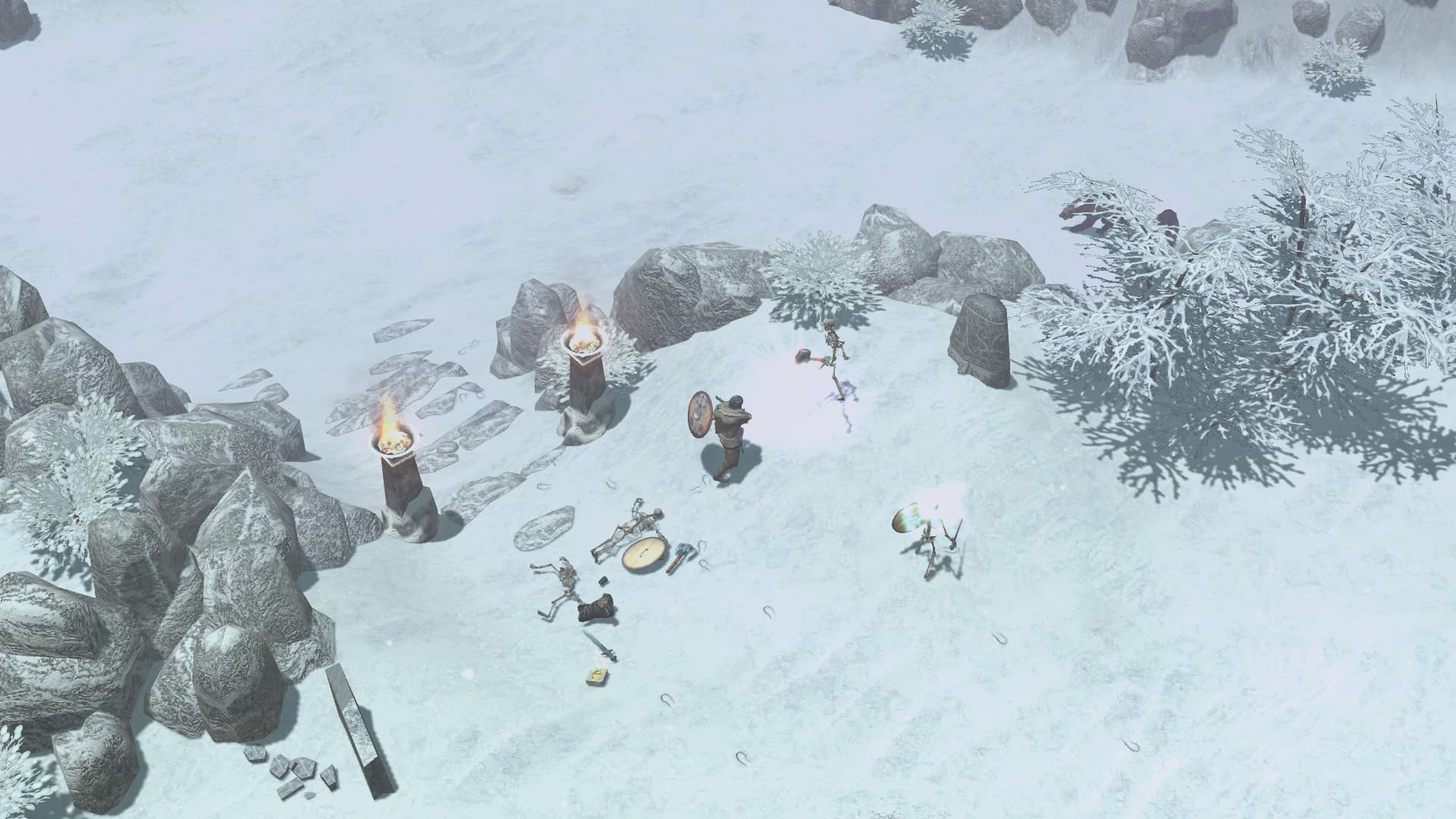
Titan Quest II leaves early access on 19 January 2027, on PC, PlayStation 5 and Xbox Series X|S. Its masteries so far are Earth, Forge, Rogue, Storm, Warfare and Spirit, and veterans of the first game will spot the gap: Rune, the mastery the Ragnarok add-on brought in 2017, the one that let a hero cut a Runeword into a blade and fight the giants of the North. Before the sequel lands, the old question deserves an answer. Were those runes real?
No. The runes in Titan Quest are battle spells with rune in the name, not letters. None of the Rune mastery's 22 skills writes a sound, and none carries a real rune's name.
What makes Titan Quest worth its own answer is one word: Runeword. Four of its skills carry it, and each is an engraving that changes your weapon. Real Germanic carvers did something close to that 1,600 years ago. They cut short charm words, the best known being alu, onto stones and gold pendants. The game kept the purpose and dropped the spelling. A real runic charm was a word you could read aloud. A Titan Quest Runeword is a word with no letters in it.
What is a rune in Titan Quest?
A rune in Titan Quest is a skill, not an object or a sign. The Ragnarok add-on, released on 17 November 2017 by Pieces Interactive and THQ Nordic, added a tenth mastery called Rune, with 22 skills across seven tiers from mastery level 1 to 40. THQ Nordic's pitch: "Become a Runemaster, a magical warrior fighting with both, spells and weapons."
The in-game description sets the scene: "The warrior-shamans of the North inscribe their weapons and armor with magical runes, or cast them on the ground to control the battlefield." Those are the two halves of the tree:
- On the weapon: Rune Weapon, Runeword: Feather, Runeword: Explode, Runeword: Burn and Runeword: Absorb.
- On the ground: Runic Mines, Freezing Mines, Menhir Wall, Guardian Stones, Rune Field and Rune Storm.
The rest are a fighter's tools: Thunder Strike, Sacred Rage, Reckless Offense, Energy Armor. According to the Titan Quest wiki, Rune and Warfare are the two masteries that can dual-wield, and the pair together makes the Berserker class. You never find, carry or read a rune in Titan Quest. You spend skill points on one.
What is a Runeword in Titan Quest?
A Runeword in Titan Quest is a weapon enchantment learned as a skill. There are exactly four: Feather, Explode, Burn and Absorb. The game describes the first as "This basic engraving reduces the weight of a weapon or shield". Each skill names its effect in English. None of them tells you what the engraving says.
That is careful design. The name is the effect: Burn burns, Explode explodes, Feather lightens, Absorb soaks up. Players who came from Diablo II expect a runeword to be several rune stones placed in sockets in a set order. Titan Quest's version is the reverse: one word, no rune stones, no sockets, and no letters. It is a label on an enchantment.
Hold on to that last point. A word with no letters is the whole difference between this game and history.
What does the runic charm word alu mean?
Alu is a real runic charm word, cut in Elder Futhark from the 3rd to the 8th century, mostly in Scandinavia. It looks like the word for ale, and most scholars read it as a charm for protection or luck, though nobody can prove the exact meaning. It is the closest thing history has to a real runeword.
Here is where it turns up:
- Alone on the Elgesem runestone in Norway, from about 400 CE.
- Alone on the Hogrän bracteate, a gold pendant from about the same time.
- Repeated on the Skrydstrup bracteate in Denmark: laukaz alu laukaz alu. Laukaz means leek, a plant tied to health and growth.
Wikipedia's list counts at least 11 bracteates and 5 runestones with the word. It fades after the Migration Period, but the idea outlives it: the Old Norse poem Sigrdrífumál, written down centuries later, still speaks of "ale runes".
The meaning is uncertain. The form is not. Alu is three letters, ᚨ ᛚ ᚢ: ansuz, laguz and uruz, the same letters a carver used to write a name or a maker's mark. A real charm word was ordinary writing doing an extra job.
Are Titan Quest Runewords like real rune charms?
In purpose, yes; in form, no. Both put a word on an object so it does more than it otherwise would. But alu is spelled in ordinary letters that anyone literate could read aloud, while a Titan Quest Runeword is a skill with an English name and a stated effect. It contains no letters at all.
| Titan Quest Runeword | Real charm word | |
|---|---|---|
| Example | Runeword: Burn | alu |
| Made of | A skill point | Three letters: ᚨ ᛚ ᚢ |
| Can you read it? | No, it is never written | Yes: a, l, u |
| What it does | A stated combat effect | Disputed, most likely protection or luck |
| Where it goes | On your weapon, as an enchantment | On stones, gold pendants and amulets |
| How many | 4 | One word, on many objects |
The game's choice makes sense. A skill tree needs effects you can predict, and a charm whose meaning scholars still argue about cannot be balanced. But the table draws the line between a game rune and a real one more clearly than any other game on this site. In Titan Quest the effect is certain and the word is missing. On a real bracteate the word is certain and the effect is the mystery.
Is Titan Quest's Rune mastery based on Norse mythology?
Its setting is; its runes are not. Ragnarok's fifth act sends the heroes of Hades into "the uncharted lands of northern Europe", through Celtic and Norse realms up to Asgard, where the player sides with its people against the Jotunn and Loki. The gods and giants come from real myth. The runes are an invented spell school.
None of the 22 skill names is a real rune name. There is no Fehu, no Thurisaz and no Hagalaz in the tree. The stones are not Norse either: the Menhir Wall borrows a Breton word, menhir, meaning long stone, for a skill sold as the magic of the North. Titan Quest built its Greece on real myths and real places. Its North gets real gods and made-up runes.
For a game that took the opposite route, putting genuine futhark letters on its walls, see God of War. Its runes are real, if from an alphabet the Vikings had already retired.
Does Titan Quest II have runes?
Not yet. Titan Quest II, by Grimlore Games, entered early access on 1 August 2025 and reaches its full release on 19 January 2027. Its six masteries so far are Earth, Forge, Rogue, Storm, Warfare and Spirit: Forge arrived in December 2025 and Spirit in August 2026. There is no Rune mastery among them.
THQ Nordic has not named the masteries for the 1.0 release, so the Runemaster may still come back. If it does, we will update this guide.
Titan Quest runes vs. the Elder Futhark
| Feature | Titan Quest: Ragnarok (2017) | Elder Futhark |
|---|---|---|
| What one sign is | A skill in the Rune mastery | A letter with a sound, a name and a meaning |
| How many | 22 skills, 4 of them Runewords | 24 |
| Real rune names used | None | Every letter has one, such as Fehu or Ansuz |
| Charm words | Feather, Explode, Burn, Absorb | alu, laukaz, laþu |
| Can it be read? | No, nothing is written | Yes, once you learn the letters |
| In use | Since 17 November 2017 | Roughly 150 to 800 CE |
The real runes, briefly
The Elder Futhark is a 24-letter alphabet used by Germanic peoples from roughly 150 to 800 CE, cut into wood, bone, metal and stone. Each letter is a sound and a name: ansuz is a god, laguz is water, uruz is the wild ox. Most surviving inscriptions are names, makers' marks and memorials. A smaller group, like alu, read as charms.
In Norse tradition, Odin wins the runes by hanging nine nights on Yggdrasil, pierced by his own spear. Carvers combined the letters into bindrunes and sigils to hold a focused intent, and people still read them for guidance today. The same 24 letters did all of it: writing, charms and divination.
Want runes you can actually read?
Titan Quest gives you 22 rune skills and not one letter. The real futhark gives you 24 letters, and three of them spell the best-known charm word in runic history.
The easiest way in is to draw one. You can cast a free rune reading in your browser right now, using the genuine Elder Futhark and their traditional meanings. Pull a rune of the day to learn the letters one at a time, or read how online rune readings work first. The rest of the series is on the runes in games hub, including Diablo II and the six games in Why do so many games call their gear runes?, which looks at the runes real warriors cut on their spears.
The Runemaster cuts words into a blade that nobody can read. The carvers of alu cut three letters into gold, and we can still read them today. , free on iOS, Android, and the web, in English and Russian.
Frequently asked questions
Are the runes in Titan Quest real runes?
No. The runes in Titan Quest are the 22 skills of the Rune mastery, added by the Ragnarok add-on in 2017. They are battle spells and weapon enchantments with English names such as Runic Mines and Runeword: Burn. None of them writes a sound, none uses a real rune name, and nothing in the skill tree can be read as Elder Futhark.
What is the Rune mastery in Titan Quest?
Rune is the tenth mastery, added by Titan Quest: Ragnarok on 17 November 2017. THQ Nordic pitched it as the Runemaster, a magical warrior fighting with spells and weapons. Its 22 skills unlock across seven tiers, from mastery level 1 to 40. Half of them enchant your weapon, the rest place mines, stones and fields on the ground.
What are the Runewords in Titan Quest?
Four skills of the Rune mastery: Runeword: Feather, Runeword: Explode, Runeword: Burn and Runeword: Absorb. Each is an engraving that changes your weapon in combat, and the game describes Feather as a basic engraving that reduces the weight of a weapon or shield. The skill names the effect in English. It never spells the engraving out in runes.
How do you get the Rune mastery in Titan Quest?
You need Titan Quest Anniversary Edition plus the Ragnarok add-on, released on Steam on 17 November 2017. Ragnarok adds Rune as the tenth mastery, so you can pick it as your first or second mastery like any other. It also raised the level cap to 85 and brought the number of two-mastery class combinations to 45.
Can the Rune mastery dual-wield in Titan Quest?
Yes. According to the Titan Quest wiki, Rune and Warfare are the two masteries whose heroes can wield two weapons at once, and some items grant dual-wielding to other builds too. Taking Rune with Warfare gives the Berserker class. That makes the Runemaster a melee fighter first, with rune spells layered on top of the weapons.
What is the alu charm word in runes?
Alu is a word cut in Elder Futhark on objects from the 3rd to the 8th century, mostly in Scandinavia. It looks like the word for ale, and most scholars read it as a charm for protection or luck, though the exact meaning is disputed. It is written with three letters: ansuz, laguz and uruz, the same letters used for everyday words.
Where has the word alu been found?
On gold bracteates, runestones and small objects across Iron Age Scandinavia. It stands alone on the Elgesem runestone in Norway, from about 400 CE, and on the Hogrän bracteate from about the same time. The Skrydstrup bracteate in Denmark repeats laukaz alu laukaz alu. Wikipedia lists at least 11 bracteates and 5 runestones carrying it.
Are Titan Quest Runewords like real rune charms?
In purpose, yes. Both are words put on an object to make it do more than it otherwise would. In form, no. A real charm word like alu was spelled in ordinary runic letters that anyone literate could read aloud. A Titan Quest Runeword is a skill with an English name and a stated effect, and it contains no letters at all.
Does Titan Quest use real rune names?
No. None of the Rune mastery's 22 skills is named after an Elder Futhark letter. There is no Fehu, no Thurisaz and no Hagalaz anywhere in the tree. The names describe effects instead: Rune Weapon, Rune of Life, Seal of Fate, Guardian Stones, Rune Storm. Even the Menhir Wall borrows a Breton word, menhir, for a Norse-flavoured skill.
Is Titan Quest Ragnarok based on Norse mythology?
Yes. Ragnarok's fifth act sends the heroes of Hades into the uncharted lands of northern Europe, through Celtic and Norse realms and up to Asgard, where the player sides with its people against the Jotunn and Loki. The gods and giants come from real myth. The Rune mastery's runes do not: they are an invented spell school.
Does Titan Quest II have a Rune mastery?
Not so far. Titan Quest II, made by Grimlore Games, entered early access on 1 August 2025 with masteries added over time. By November 2026 they are Earth, Forge, Rogue, Storm, Warfare and Spirit. The full release is set for 19 January 2027 on PC, PlayStation 5 and Xbox Series X|S, and THQ Nordic has not yet named its masteries.
When did Titan Quest come out?
The original Titan Quest, by Iron Lore Entertainment, came out in June 2006. Immortal Throne followed in 2007, and Titan Quest Anniversary Edition arrived on 31 August 2016. Ragnarok, the add-on that brought the Rune mastery, came out on 17 November 2017, followed by Atlantis and Eternal Embers. Titan Quest II reaches its 1.0 release on 19 January 2027.
Can you read the runes in Titan Quest?
No, because nothing in the Rune mastery is written. Its skills have English names and stated effects, and the in-game text never spells a rune out. If you want runes you can read, learn the 24 letters of the Elder Futhark. With them you can read alu on a 1,600-year-old gold pendant the way its owner read it.
Where can I try a real rune reading online?
You can cast a free rune reading in your browser with the Way of the Runes rune-reading tool. It uses the genuine 24 Elder Futhark runes and their traditional meanings, with quick single draws for a fast question and fuller spreads for something weightier, and a full description for every rune. It works on any device, in English and Russian.
Which rune are you?
Seven questions, about a minute, and you get one of the 24 Elder Futhark runes. The scoring is shown as you answer. Free, no signup.