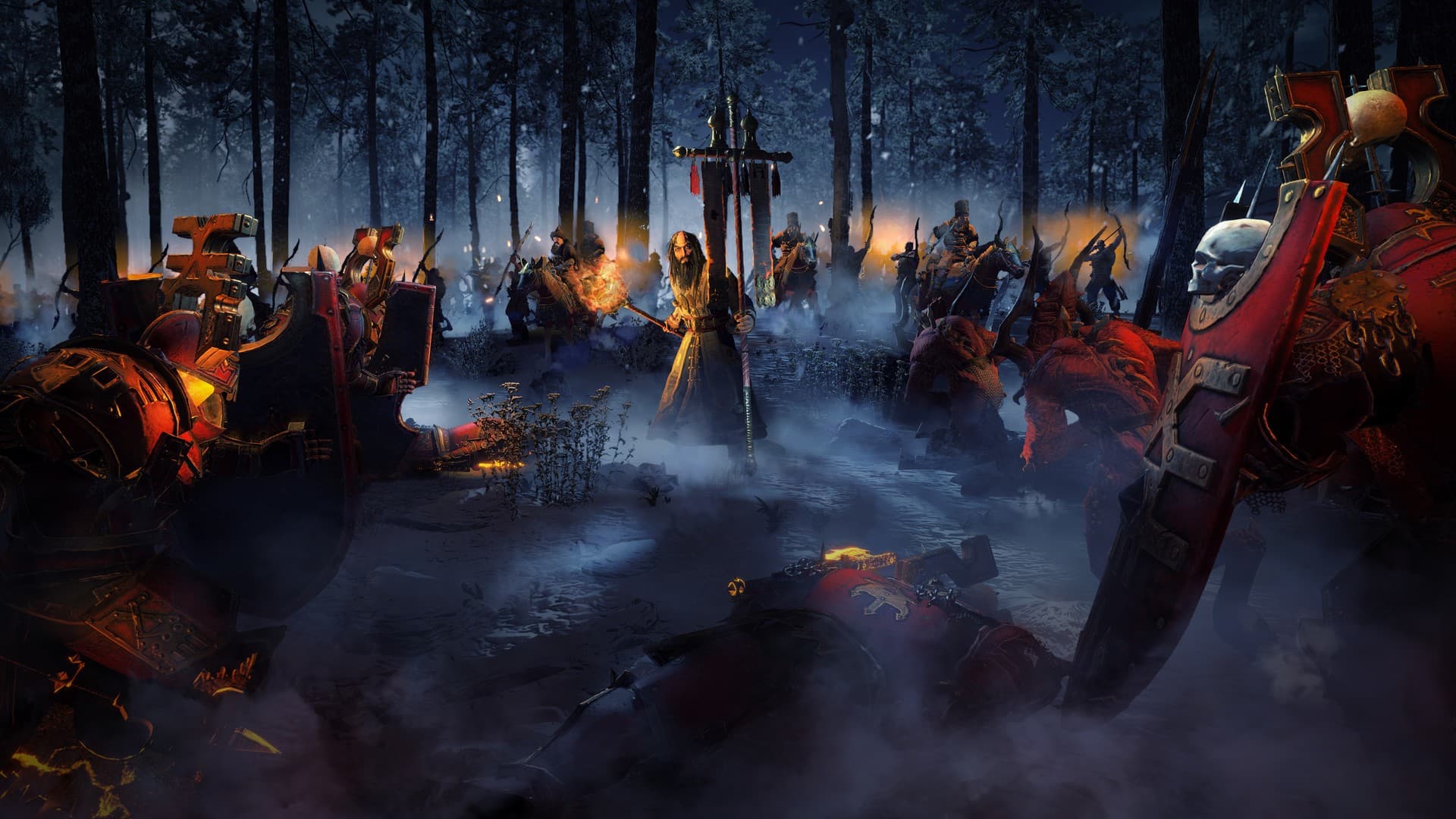
Total War: Warhammer turned ten on 24 May 2026, and its third game had sold 2.34 million copies by March 2025. Many of those players have recruited a Runesmith, watched him raise a hammer over a Dwarf battle line, and clicked an ability called Rune of Wrath and Ruin. Then the question comes.
No. The runes in Total War: Warhammer are Dwarf magic struck on an anvil, not letters. They come from Games Workshop's Warhammer setting, and not one of them has a sound.
What makes this trilogy worth its own answer is a naming habit. Its best runes carry a person's name: the Master Rune of Skalf Blackhammer, the Master Rune of Alaric the Mad. In the lore, those are the smiths who first struck them. A real golden horn from Denmark carries a smith's name too, in genuine runes, and it does the opposite job. Warhammer turns a smith's name into a power. Real runes turned it into a sentence.
What is a rune in Total War: Warhammer?
A rune in Total War: Warhammer is Dwarf magic bound into an object, and it comes in two forms.
- In battle, it is an ability. Runesmith heroes and Runelord lords use Runic Magic, which does not spend the Winds of Magic pool that wizards draw on. Since Total War: Warhammer II, each rune has its own cooldown, and casting any rune also starts a shorter shared one.
- On the campaign map, it is an item. Dwarf factions craft character runes and banner runes at the Forge, paying in a resource called Oathgold, and fit them to lords, heroes and units.
Both forms date back to the Dwarfs' arrival on 24 May 2016, when Creative Assembly and SEGA released the first game with the Dwarfs among its launch races. The Forge came later, in July 2021, alongside Thorek Ironbrow.
Struck, not written: how do runes work in battle?
A Total War: Warhammer rune is used, not read. Rune of Wrath and Ruin is listed at a 120 second cooldown and, in Warhammer II, a 60 second shared cooldown; the Warhammer III data gives it a 10 second duration and unlimited uses. The verb behind all of it comes from the tabletop game: Dwarfs strike runes.
The first game's Runesmith tree reads like a list of jobs: Rune of Hearth and Home, Rune of Fortitude, Rune of Negation, Rune of Parrying, Rune of Spellbreaking, Rune of Fury. Update 5.0 on 30 April 2024 added Ancestor Rune, Rune of Courage and Rune of Stoicism.
The Anvil of Doom shows the idea most plainly. It is a Runelord mount, added in October 2016 with The King and the Warlord, and the community wiki lists 25% physical resistance, 5% spell resistance and a Locus of Power aura. Thorek Ironbrow's anvil adds the Rune of Doom: +24 melee attack across the map for 16 seconds, every 90 seconds.
Games Workshop's rules describe the sound. In the 7th edition Dwarf book, "with each blow of the hammer a low bass note resonates across the battlefield". In the current Warhammer: The Old World rules, Rune of Oath and Steel makes "Dwarf mail" harden, "each suit of armour remembering the hammer blows that forged it". A Warhammer rune is a blow of a hammer. A futhark rune is a letter cut with a knife, so that someone else could read it later.
The Forge: what are character runes and banner runes?
The Forge is the campaign's rune workshop. Creative Assembly's own announcement split crafting into two types, character runes and banner runes, both paid for in Oathgold, with each craft giving a batch to spread across your armies. A lord or hero wears them in a Character Runes section with 3 slots.
A common rune such as the Rune of Iron costs 300 Oathgold, and the wiki lists a cap of three of a kind. The master runes cost more, and you may own only one of each:
| Rune | Kind | Oathgold | What it does |
|---|---|---|---|
| Master Rune of Gromril | Master rune, one only | 500 | +50 armour, 10% physical resistance |
| Master Rune of Skalf Blackhammer | Master rune, one only | 500 | 30% weapon strength, +30 armour-piercing damage |
| Master Rune of Alaric the Mad | Master rune, one only | 500 | -75 base weapon damage, +75 armour-piercing damage |
Read the last column and you see the shape of the system. A rune is a number with a price. A master rune is a bigger number with a bigger price and a limit of one. Nothing in the table spells anything, and you could rename every rune without changing a single battle.
Why are master runes named after smiths?
Look at the names again. The common runes are named after materials and jobs: iron, fortitude, parrying. The master runes have the names of people.
In the Warhammer lore, Skalf Blackhammer is a legendary runesmith credited with many great hammers; some stories say he made Sigmar's. Alaric the Mad made the twelve Runefangs, the swords of the Empire's Elector Counts, and earned his name hunting a new Master Rune of Ages, a search that ended in the cursed Nemesis Crown. The rune keeps the name of the smith who first struck it, the way a famous recipe keeps its chef.
That is a signature. And it is the one place where Total War: Warhammer comes close to what real runes were for, because the oldest runic signatures in the North are not powers. They are sentences.
The golden horn that names its maker
In 1639, a peasant girl named Kirsten Svendsdatter found a gold horn sticking out of the ground near the village of Gallehus, in southern Denmark. In 1734, a farmer found a second, shorter one about 15 to 20 metres away. Both are dated to the early 5th century. The shorter horn, 50 centimetres long and 3.7 kilograms of double sheet gold, carried a line of Elder Futhark around its rim:
ek hlewagastiz holtijaz horna tawido: "I, Hlewagastiz Holtijaz, made the horn."
That is a real smith's signature, about 1,600 years old. Holtijaz may mean "son of Holt" or "of the wood". The line does not make the horn stronger, louder or harder to break. It tells you who made it, in five words you can still sound out letter by letter.
The horns themselves are gone. On 4 May 1802, a goldsmith and watchmaker named Niels Heidenreich got into the royal collection with forged keys, carried both horns home and melted them down for the gold. Every replica, including the pair in the National Museum of Denmark, rests on drawings made before the theft. So the smith Hlewagastiz is remembered only because his runes were writing: people could copy the words before the metal was lost.
He is not alone. The 10th-century Seax of Beagnoth carries its smith's whole futhorc alphabet and the name Beagnoth inlaid along the blade, and early spearheads carry a weapon's own name, as our guide to why games call gear runes shows. In Warhammer, Skalf's name is a power you pay 500 Oathgold to use. On a real horn, Hlewagastiz's name is simply what the runes say.
Total War: Warhammer runes vs. the Elder Futhark
| Feature | Total War: Warhammer (2016) | Elder Futhark |
|---|---|---|
| What one sign is | An ability or a crafted item | A letter with a sound, a name and a meaning |
| How many | Dozens of abilities and Forge runes, across three games | 24 |
| How it is made | Struck on an anvil, crafted with Oathgold | Cut or inlaid into wood, bone, metal and stone |
| A smith's name | Part of a master rune's title | Written out as a sentence, as at Gallehus |
| Can it be read? | No, it is an icon with a tooltip | Yes, once you learn the letters |
| In use | Since 24 May 2016 | Roughly 150 to 800 CE |
The real runes, briefly
A real rune is first a letter. The Elder Futhark has 24 of them, used from roughly 150 to 800 CE, and each one is a sound, a name and a word: Fehu is cattle and wealth, Ansuz a god, Uruz the wild ox. That is why the Gallehus line can still be read today. The sounds are on the horn, in order.
Belief came on top of the writing. In Norse tradition, Odin wins the runes by hanging nine nights on Yggdrasil, pierced by his own spear. Later the runes served as charms and protections, were combined into bindrunes and sigils to hold a focused intent, and were read for guidance, a practice that continues today.
Why the Old World has no room for real runes
Total War: Warhammer is set in Games Workshop's Warhammer world, a fantasy setting first published in 1983. Its Dwarfs have their own ancestor gods, among them Grungni and Valaya, and their own history of runesmiths, guilds and grudges. There is no Odin, no Eddas and no Yggdrasil anywhere in the trilogy.
Even the Viking corner of the map is not where the runes live. Norsca, the most Norse-looking faction, became playable in August 2017. The runes belong to the Dwarfs, who owe more to Tolkien's smiths than to any real carver. For the Tolkien side of that family tree, see Are the runes in the Middle-earth games real?; for another set of dwarves who work runes into gear, see Dragon Age.
Inside its own world, the choice works. A Dwarf army that fights with hammer blows and signed recipes feels right. It just leaves out the one thing a real rune always had: a sound.
Want runes you can actually read?
Total War: Warhammer gives you runes that do things on a cooldown. The Elder Futhark gives you 24 that say things, and the oldest of them have been saying the same words for 1,600 years.
The easiest way in is to draw one. You can cast a free rune reading in your browser right now, using the genuine Elder Futhark and their traditional meanings, with a quick single draw for a fast question or a fuller spread for something weightier. If you would rather build the habit slowly, pull a rune of the day each morning and learn the futhark one sign at a time, or read how online rune readings work first. The rest of the series is on the runes in games hub, including Crusader Kings III, the other strategy game in the set, whose runestones mirror real Viking monuments.
Skalf Blackhammer's name sells for 500 Oathgold. Hlewagastiz wrote his own on a horn, and you can still read it. , free on iOS, Android, and the web, in English and Russian.
Frequently asked questions
Are the runes in Total War: Warhammer real runes?
No. The runes in Total War: Warhammer are Dwarf magic from Games Workshop's Warhammer setting: battle abilities that Runesmiths and Runelords strike, and character and banner runes crafted at the Forge. None of them is a letter, none has a sound, and none comes from the Elder Futhark. They borrow the word and the mood of real runes, then give them a cooldown and a stat line.
What is Runic Magic in Total War: Warhammer?
Runic Magic is the Dwarfs' battle magic, used by Runesmith heroes and Runelord lords. It does not draw on the Winds of Magic pool that wizards spend. Since Total War: Warhammer II each rune has its own cooldown, and casting any rune also starts a shorter shared cooldown on that character. Rune of Wrath and Ruin, for example, is listed at a 120 second cooldown.
What runes can a Runesmith use in Total War: Warhammer?
The first game's Runesmith skill tree includes Rune of Hearth and Home, Rune of Wrath and Ruin, Rune of Fortitude, Rune of Negation, Rune of Parrying, Rune of Spellbreaking and Rune of Fury, among others. Most are buffs for nearby Dwarfs or answers to enemy spells. Update 5.0 for Warhammer III, released on 30 April 2024, added abilities such as Ancestor Rune, Rune of Courage and Rune of Stoicism.
What does the Anvil of Doom do in Total War: Warhammer?
The Anvil of Doom is a Runelord mount, added to the first game with The King and the Warlord DLC in October 2016. The community wiki lists 25% physical resistance, 5% spell resistance and the Locus of Power passive. Thorek Ironbrow's anvil adds the Rune of Doom, a map-wide boost of 24 melee attack for 16 seconds on a 90 second cooldown.
How do you craft runes in Total War: Warhammer?
At the Forge, with Oathgold. Since the 2021 update that made Thorek Ironbrow a free legendary lord, Dwarf factions can craft runes in two kinds, character runes and banner runes, and each craft yields a batch to spread across armies. A character equips them from the Character Details screen, in a Character Runes section with 3 slots.
What are master runes in Total War: Warhammer?
Master runes are the strongest character runes at the Forge, and you can hold only one of each. The community wiki lists them at 500 Oathgold, against 300 for a common rune such as the Rune of Iron. The Master Rune of Gromril gives +50 armour and 10% physical resistance; the Master Rune of Skalf Blackhammer gives 30% weapon strength and 30 armour-piercing damage.
Why are Dwarf runes named after people in Warhammer?
Because in the lore a master rune keeps the name of the runesmith who first struck it. Skalf Blackhammer is a legendary smith credited with many great hammers. Alaric the Mad made the twelve Runefangs, and his hunt for a new Master Rune of Ages led to the cursed Nemesis Crown. The rune is the smith's signature, written as a power instead of a word.
Can you read the runes in Total War: Warhammer?
No. A Total War: Warhammer rune is an ability or an item, shown as an icon with a name and a tooltip. There is no alphabet behind it and no sentence to decode. You learn what a rune does from the numbers, not from its shape. The real Elder Futhark works the other way: each of its 24 letters is a sound you can read aloud.
Are Warhammer Dwarf runes based on the Elder Futhark?
No. Games Workshop's Dwarfs borrow the idea of runes from Germanic tradition, through the same Tolkien-shaped fantasy that made dwarves smiths, but Runic Magic has no letters to map. The Elder Futhark is a 24-letter Germanic alphabet used from roughly 150 to 800 CE. A Warhammer rune is a named effect; a futhark rune is a sound.
What is the golden horn of Gallehus?
One of two gold horns found at Gallehus in southern Denmark, in 1639 and 1734, and dated to the early 5th century. The shorter horn carried an Elder Futhark inscription: ek hlewagastiz holtijaz horna tawido, I Hlewagastiz Holtijaz made the horn. Both originals were stolen and melted down by a goldsmith in 1802. Replicas stand in the National Museum of Denmark.
Did real smiths sign their work with runes?
Yes, sometimes. The Gallehus horn names its maker in Proto-Norse, and the 10th-century Seax of Beagnoth has its smith's inlaid futhorc alphabet and the name Beagnoth along the blade. Other early inscriptions name a weapon, an owner or a carver. In every case the runes record who or what, as words. None of them adds armour to anything.
Which Total War: Warhammer games have runes?
All three. Total War: Warhammer, released on 24 May 2016, introduced the Dwarfs with Runesmiths and Runelords. Total War: Warhammer II, from 28 September 2017, added the rune cooldown rules and later the Forge. Total War: Warhammer III, from 16 February 2022, carries the Dwarfs into its Immortal Empires campaign and kept reworking their runes.
Is Total War: Warhammer based on Norse mythology?
No. It is set in Games Workshop's Warhammer world, a fantasy setting first published in 1983, with its own Dwarf ancestor gods such as Grungni and Valaya. Its most Viking-like faction is Norsca, playable since August 2017, and the runes do not belong to it. They belong to the Dwarfs. There are no Odin, Eddas or Yggdrasil anywhere in the trilogy.
Where can I try a real rune reading online?
You can cast a free rune reading in your browser with the Way of the Runes rune-reading tool. It uses the genuine 24 Elder Futhark runes and their traditional meanings, with quick single draws for a fast question and fuller spreads for something weightier, and a full description for every rune. It works on any device, in English and Russian.
Which rune are you?
Seven questions, about a minute, and you get one of the 24 Elder Futhark runes. The scoring is shown as you answer. Free, no signup.