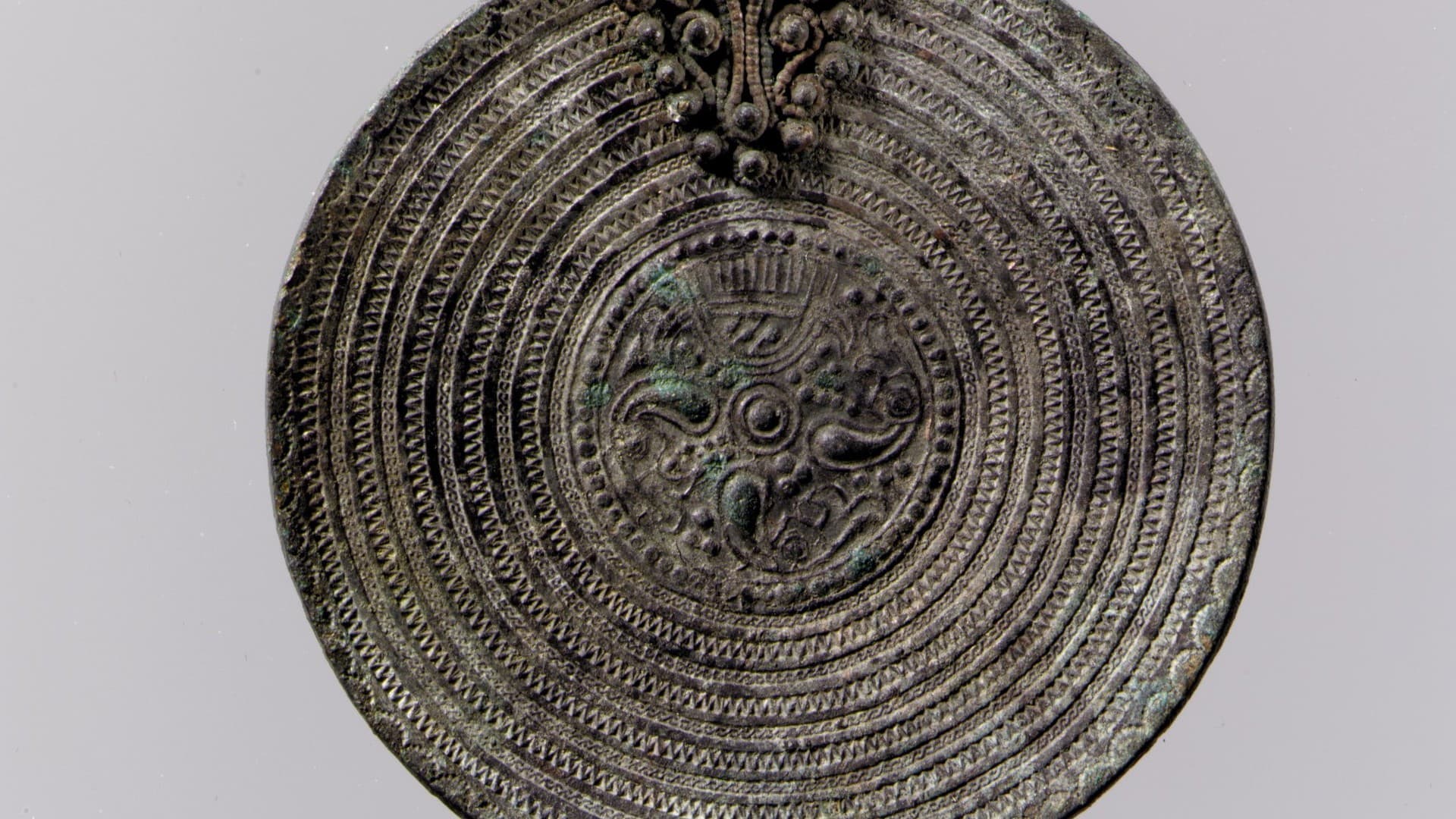
The Helm of Awe is the tattoo that looks like a weapon: eight arms tipped with tridents, radiating from a centre like a warning. It is sold as Aegishjalmur, the Viking symbol of invincibility, worn by warriors before battle. Anyone who looks into it soon asks whether any of that is true.
Partly. The name Helm of Awe is Viking myth; the eight-armed drawing is Icelandic magic from about 1550 onwards. The two are real, and they are about five hundred years apart.
That makes the Helm of Awe the one popular stave with a genuine Eddic name behind it, which is where it gets interesting. The only Eddic scene with the helm is a dragon boasting about it while he dies, and the hero telling him it never worked. The oldest story about the Helm of Awe is about its failure.
What is the Helm of Awe?
The Helm of Awe, in Icelandic Aegishjalmur, is a magical stave, a galdrastafur: usually eight arms ending in tridents, crossed by bars, around a small circle. The name joins aegir, one who frightens, from agi, awe or terror, with hjalmr, helmet or covering. It promises two things: protection, and fear in anyone who faces the bearer.
The word is older than the drawing, and it names two different things. In the Eddic poems it is an object, a helm in the hoard of the dragon Fafnir. In Icelandic books of magic of the 1500s to 1800s it is a sign drawn on paper, cut into livestock or pressed onto a forehead. The Norse symbols hub sorts it among the other popular symbols by its oldest source.
Is the Helm of Awe really Viking?
The name is; the drawing is not. The Poetic Edda poems about Fafnir carry myths from the Viking Age world, written down in Iceland in the 13th century. The eight-armed stave first appears in the Galdrabok, an Icelandic book of magic written by four scribes between about 1550 and 1650. The Viking Age ended around 1066, so the drawing comes about five centuries too late.
No runestone, picture stone, amulet or weapon from the Viking Age shows the stave. No saga describes its shape. What the medieval texts give us is a name and an effect, never a picture.
| Claim | What the source shows |
|---|---|
| "Vikings drew it before battle" | No Viking Age object or text shows the drawing |
| "It is in the Eddas" | The name is; the Edda describes a helm, not a sign |
| "It made its wearer invincible" | In Fafnismal the owner dies, and Sigurd says it never protected him |
| "It is made of runes" | It is a drawn stave; no arm is a futhark letter |
| "There is one true design" | Lbs 2413 8vo, about 1800, lists nine different helms of awe |
| "It is pagan" | The books that draw it were written by Icelandic Christians |
The helm in the Poetic Edda
The helm belongs to Fafnir, a man who killed his father for a cursed treasure and became a dragon to guard it. The prose before the poem Reginsmal says he owned the helm of awe, and every living thing feared it. In Volsunga saga, after the hero Sigurd kills Fafnir, the helm is among the treasures Sigurd carries away from the hoard.
The key scene is in Fafnismal, the poem of the dying dragon. In stanza 16 Fafnir boasts, in Henry Adams Bellows' translation: "The fear-helm I wore to afright mankind, while guarding my gold I lay." He felt stronger than everyone around him.
Sigurd answers in the next stanza that the helm shelters no one who must fight a brave man. A few lines later he goes further: men hate whoever owns the helm. Fafnir is lying in his own blood as they speak.
So the only Viking myth about the Helm of Awe is not a victory story. It is a lesson about a weapon of fear that fails the moment it meets courage, and about the hatred it earns its owner. That is a better meaning than "invincible", and it is the original one.
Where does the drawn Helm of Awe come from?
The drawn Helm of Awe comes from Icelandic books of magic, galdrabaekur, copied by hand between the 1500s and the 1800s. They mix Christian prayers, Latin and Hebrew names from European grimoires and older Norse words. Three sources carry the Helm of Awe's story:
- The Galdrabok (about 1550 to 1650). Several helms of awe are drawn, and the book tells the reader to cut them onto livestock that suffer from swooning or pestilence. The Swedish scholar Natan Lindqvist first published it in 1921; Stephen Flowers translated it into English in 1989.
- The Galdrakver Lbs 143 8vo (about 1670), later part of the collection of Bishop Hannes Finnsson. It gives the most quoted instruction: make the sign in lead, and when a man expects his enemies, press it onto his forehead, and he will overcome them.
- Lbs 2413 8vo (about 1800). It lists nine helms of awe that no one who handles such knowledge can be without, each drawn differently.
The Helm of Awe was not a safe thing to own in those centuries. Iceland applied the Danish law against sorcery from 1630, and 22 people were executed for witchcraft between 1625 and 1685. A page of staves could be evidence. Today the stave is the logo of the Museum of Icelandic Sorcery and Witchcraft in Holmavik, which tells that history.
Helm of Awe vs Vegvisir
The Helm of Awe and the Vegvisir are the two staves most often mixed up. Both have eight arms and both are Icelandic, but their sources, ages and purposes differ.
| Feature | Helm of Awe | Vegvisir |
|---|---|---|
| Name | Aegishjalmur, helm of awe | Vegvisir, wayfinder |
| Oldest mention of the name | Poetic Edda, written down 13th century | Huld manuscript, 1860 |
| Oldest drawing | Galdrabok, about 1550 to 1650 | Huld manuscript, 1860 |
| Purpose | Fear, protection, victory over enemies | Not losing the way in storms |
| Arm ends | Tridents, crossed by bars | Mixed forks, crosses and circles |
| How it was used | Cut onto livestock, pressed in lead on the forehead | Carried on the body |
In short: the Helm of Awe is older, has a myth behind it and is about fear. The Vegvisir is younger, has no myth and is about travel.
Is the Helm of Awe made of runes?
No. The Helm of Awe is a stave, and it cannot be read. Its tridents and bars are not letters of the Elder Futhark, the 24-letter alphabet carved from roughly 150 to 800 CE, and it does not spell a word.
Some modern designs read the trident ends as the rune Algiz, the rune most often linked to protection today, or put a ring of runes around the stave. Both are recent additions. A sign that joins real runes, each still a letter, is a bindrune: see our guide to runic sigils, or build one in the bindrune generator.
Helm of Awe tattoo: what to know first
A Helm of Awe tattoo carries a meaning with real sources behind it: protection, and a presence that makes enemies back off. The Galdrakver wanted the sign on the forehead before a fight, so a tattoo is close to its original use.
Three things are worth knowing first:
- It is Icelandic, not Viking. The name is from the Edda, the drawing from books of magic written five centuries later. If Viking Age finds are what you want, look at Thor's hammer in our Mjolnir guide or the Valknut shape.
- There is no single correct design. The old books draw many helms of awe, with different numbers of arms and ends. The eight-trident version is the modern standard, not the only historical one.
- Know the modern baggage. Scholars Alessia Bauer and Alexandra Pesch note that its martial image made the stave popular with some far-right groups, and it shaped the logo of the Swedish neo-Nazi Svenskarnas parti. The same stave is also a museum logo in Iceland.
It is often sold as a berserker symbol too. It is not: no source links the berserkers to any emblem.
Why the Viking Age did not need a drawn helm
The Vikings had the idea without the picture. Their fear-helm was a treasure in a myth, owned by a dragon and taken by a hero. Their own protective signs, where we can see them, were runic inscriptions and god symbols like the hammer of Thor. A drawn circle of tridents came later, from Christian Iceland, from paper books and from European magic.
That does not make the Helm of Awe fake. It is a genuine piece of Norse tradition in its Icelandic afterlife, and its name reaches back to the myths of Odin's world. It is honest to wear it as that: an old name, a later drawing, and a story that warns against trusting fear.
Want signs you can actually read?
The Helm of Awe frightens; it does not speak. The 24 runes of the Elder Futhark each carry a sound, a name and a meaning, and you can learn to read them.
The easiest way in is to draw one. You can cast a free rune reading in your browser right now, using the genuine Elder Futhark and their traditional meanings. If you prefer to go slowly, pull a rune of the day each morning, or read how online rune readings work first. And if you came here from a game, the runes in games series checks which game runes are real.
Sigurd was right about the helm: courage beats fear. For signs that talk back, , free on iOS, Android, and the web, in English and Russian.
Frequently asked questions
Is the Helm of Awe a Viking symbol?
Only the name. The Poetic Edda gives the dragon Fafnir an aegishjalmur, a helm of awe, that frightens everyone who sees it. No Viking Age object shows the eight-armed drawing, though. That appears first in the Icelandic Galdrabok, written about 1550 to 1650, some five centuries after the Viking Age ended around 1066.
What does the Helm of Awe mean?
Its meaning is fear and protection. The Old Norse name joins aegir, one who frightens, from agi, awe or terror, with hjalmr, helmet or covering. In the Edda it makes Fafnir terrifying. In the Icelandic books of magic the stave protects livestock from pestilence and helps a man overcome his enemies when he wears it on his forehead.
What is Aegishjalmur?
Aegishjalmur is the Icelandic spelling of the Helm of Awe, also written Aegishjalmr in Old Norse. The word names two different things. In the Poetic Edda and Volsunga saga it is a real helm in Fafnir's hoard. In Icelandic books of magic from about 1550 onwards it is a drawn stave, usually a circle of arms ending in tridents.
Where does the Helm of Awe come from?
The name comes from the Eddic poems about Sigurd and Fafnir, written down in Iceland in the 13th century. The drawing comes from Icelandic grimoires: the Galdrabok of about 1550 to 1650, the Galdrakver Lbs 143 8vo of about 1670, and later books such as Lbs 2413 8vo of about 1800, which lists nine different helms of awe.
Who wore the Helm of Awe in Norse mythology?
The dragon Fafnir. In the Eddic poem Fafnismal he tells Sigurd that he wore the helm of awe against the sons of men while he lay on his gold. The prose before Reginsmal says every living thing feared it. After Sigurd kills him, Volsunga saga lists the helm among the treasures Sigurd takes from the hoard.
Did the Helm of Awe work in the myth?
No. In Fafnismal the dying Fafnir boasts that the helm made him unbeatable, and Sigurd answers that the helm shelters no one who must fight a brave man. A few stanzas later he adds that men hate whoever owns it. The only Eddic scene with the helm is the scene where it fails.
How was the Helm of Awe used in Icelandic magic?
In several ways. The Galdrabok tells the reader to cut helms of awe onto livestock that suffer from swooning or pestilence. The Galdrakver of about 1670 says to make the sign in lead and press it onto the forehead when you expect to meet your enemies, so that you overcome them. A later book, Lbs 2413 8vo, draws nine different helms of awe.
Is the Helm of Awe made of runes?
No. The Helm of Awe is a galdrastafur, a drawn magical stave built from arms, tridents, bars and circles. None of its parts is an Elder Futhark letter, and it does not spell anything. Some modern designs add runes around it or read the arm ends as Algiz runes, but the early modern drawings are staves, not writing.
What is the difference between the Helm of Awe and the Vegvisir?
Both are eight-armed Icelandic staves, which is why they get confused. The Helm of Awe has an Eddic name and a drawing from about 1550 to 1650, and it is for fear and protection. The Vegvisir is a wayfinding charm first drawn in 1860, with no old name behind it. Their arms end differently: tridents on the helm, mixed forks on the Vegvisir.
Is it bad to wear the Helm of Awe?
No, it is widely worn and it is not a hate symbol in itself. One caution: scholars Alessia Bauer and Alexandra Pesch note that its martial image has made it popular with some far-right groups, and it shaped the logo of the Swedish neo-Nazi Svenskarnas parti. Most wearers mean protection, and knowing the real history helps if someone asks.
What does a Helm of Awe tattoo mean?
Historically, protection and the power to make enemies afraid. The Galdrakver of about 1670 wanted the sign on the forehead before meeting enemies, so a tattoo is a permanent version of the same idea. What a Helm of Awe tattoo does not show is a Viking heritage: the drawing is Icelandic and roughly 500 years younger than the Viking Age.
How many arms does the Helm of Awe have?
Most versions today have eight arms ending in tridents around a small circle. The old books are less strict. The Galdrabok draws several different helms, and the manuscript Lbs 2413 8vo of about 1800 lists nine helms of awe, each with its own shape. There is no single correct Helm of Awe, only a popular standard form.
How do you pronounce Aegishjalmur?
In modern Icelandic it sounds roughly like EYE-yis-hyowl-moor, with the stress on the first syllable. The Old Norse form aegishjalmr has no final -ur. The first part is related to the English word awe, which came into English from Old Norse agi, so helm of awe is a close and accurate translation of the name.
Where can I try a real rune reading online?
You can cast a free rune reading in your browser with the Way of the Runes rune-reading tool. It uses the genuine 24 Elder Futhark runes and their traditional meanings, with quick single draws for a fast question and fuller spreads for something weightier, and a full description for every rune. It works on any device, in English and Russian.
Which rune are you?
Seven questions, about a minute, and you get one of the 24 Elder Futhark runes. The scoring is shown as you answer. Free, no signup.