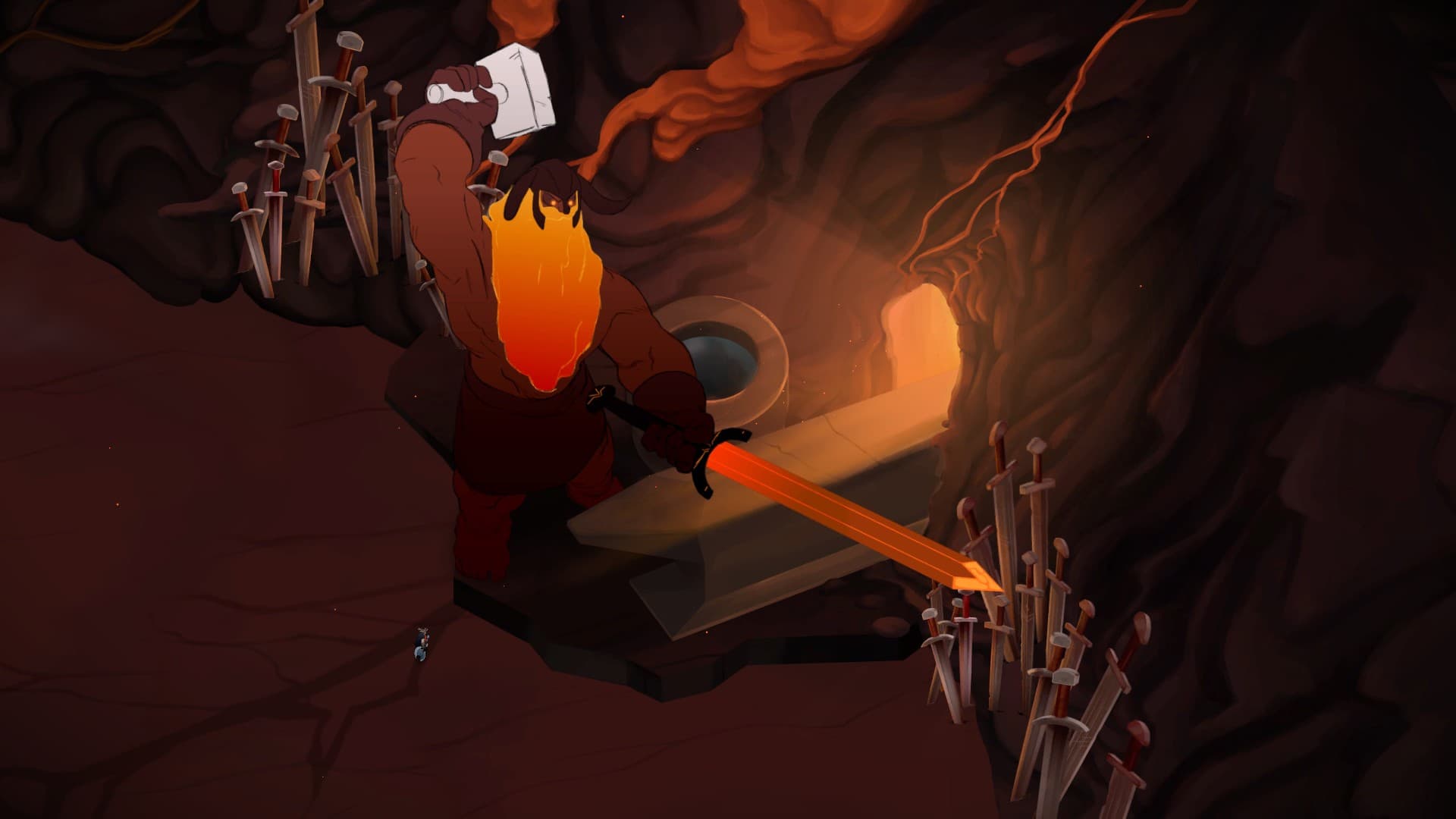
Jotun opens with a death. Thora, a Viking warrior, has died badly, and she wakes in Ginnungagap, the void before creation, with Odin's voice telling her in Icelandic what she must do to reach Valhalla. Then the first giant rises out of the ground, and its name is a rune: Jera.
Partly. The giants in Jotun carry five real rune names, and each one acts out its rune's meaning, but the runes Thora collects are keys, not letters. Nothing in the game spells a word.
What makes Jotun worth its own answer is how carefully those names were chosen, and from where. Four of them are modern scholars' reconstructions of words no one ever wrote down. One is the medieval Norse name from the rune poems. And each giant behaves like its verse in those poems. Thunder Lotus did not borrow the letters. It borrowed the poems.
What is a rune in Jotun?
A rune in Jotun is an object at the end of a stage that Thora must reach to move the story on. It is not a spell, not gear and not a letter. Reach the runes of an area and its giant wakes in Ginnungagap.
The structure is simple. Ginnungagap is the hub, and it leads to five areas. Four areas have two stages each and Jera's has one, so there are nine stages and nine runes. Each stage also has a god shrine that unlocks or upgrades a power: Frigg's Healing, Freya's Speed, Thor's Hammer, Odin's Spear, Loki's Decoy and Heimdall's Shield. Each starts with two charges and refills at Mimir's Wells. Hidden Ithunn's Apples raise Thora's health for good.
So the power in Jotun comes from the gods, and the runes only open doors. Defeat all five giants and Thora fights Odin himself.
Which runes are the five giants named after?
Every giant takes the name of a real rune, and its element matches what that rune means.
| Giant | Element | Stages | The real rune |
|---|---|---|---|
| Jera | Plant | The Barrow Mound | Jera, year and harvest |
| Fé | Warrior | The Roots of Yggdrasil, Brokkr's Forge | Fehu, cattle and wealth |
| Isa | Ice | Jormungandr's Lake, The Nine Rivers | Isa, ice |
| Hagalaz | Lightning | Vethrfolnir's Roost, The Northern Sky | Hagalaz, hail |
| Kaunan | Fire | The Crater, Ymir's Blood | Kenaz, ulcer or torch |
Most games that borrow rune names stop at the label. Ragnarok Online, for one, hangs real names on invented powers. Jotun goes the other way: it starts from what the rune meant and draws a giant to fit. An ice rune becomes an ice giant whose beard is jagged ice. A harvest rune becomes a giant half-buried in the soil. The signs are there too: the official screenshots show each arena floor cut with its giant's rune, ᚠ under Fé and ᚺ under Hagalaz, the Elder Futhark form of hail with one crossbar where the Younger Futhark used ᚼ.
Why are four names reconstructed and one Old Norse?
Because the names come from two different layers of the language, about a thousand years apart.
No one in the Elder Futhark period, roughly 150 to 800 CE, wrote down what the runes were called. The names we use for them, jera, isa, hagalaz, kaunan, fehu, are reconstructions: scholars work back from the later names recorded in medieval poems to the Proto-Germanic words they must have come from. Four of Jotun's giants carry these reconstructed forms.
The fifth does not. Fé is the Old Norse name of the f-rune exactly as the Norwegian and Icelandic rune poems write it: Fé vældr frænda róge, "wealth is a source of discord among kinsmen". By then the Vikings were writing in the 16-letter Younger Futhark, and fé was the first letter of it.
So Jotun's five names were never spoken together by anyone. A Proto-Norse carver of 400 CE would have said something close to jera and isa but not fé; a Viking of 1000 CE would have said fé, ár and íss. The game mixes the scholar's reconstruction with the skald's word, and only a modern reader of runes would put them side by side.
Kaunan has its own twist. The k-rune has two traditions. The Norse poems call it kaun, ulcer, and kaunan is rebuilt from that. The Anglo-Saxon poem calls it cen, torch, and that is where the name kenaz comes from. Jotun's fire giant takes the ulcer name and plays the torch meaning.
Do the giants match the rune poems?
Closely enough that it is hard to call it chance. Three medieval poems, one Anglo-Saxon, one Norwegian and one Icelandic, give a short verse for each rune. Set the giants beside them:
- Isa, the ice giant, guards Jormungandr's Lake and The Nine Rivers. The Icelandic poem: Ís er árbörkr ok unnar þak, "ice is the bark of rivers and the roof of the wave".
- Hagalaz, the lightning giant, waits in The Northern Sky. The Anglo-Saxon poem: hail "is whirled from the vault of heaven and is tossed about by gusts of wind".
- Jera, the plant giant, rises from the earth. The Icelandic poem: Ár er gumna góði ok gott sumar, algróinn akr, "plenty is a boon to men, and a good summer, a thriving cornfield".
- Kaunan, the fire giant, fights in The Crater and Ymir's Blood. The Anglo-Saxon poem: the torch "is known to every living man by its pale, bright flame".
- Fé, the warrior giant, is the loosest fit, but the Icelandic verse explains it: Fé er frænda róg, "wealth is kinsmen's strife". Wealth in these poems is what men fight over.
That last one is the clearest sign of a designer reading the poems rather than a modern meanings list. Popular books call fehu abundance and prosperity. The Norse verses call it strife. Jotun made it a warrior.
Where is the giant rune?
Here is the irony. Jotun is a game about giants, and the futhark has a rune whose name means giant. It is not in the game.
The third rune, thurisaz, is called þurs in the Norwegian and Icelandic poems, and a þurs is a giant: Þurs er kvenna kvöl ok kletta búi, "giant is the torment of women and the cliff-dweller". The Anglo-Saxon poem renamed it thorn, but in the Norse world the rune was the giant itself.
Thunder Lotus chose its five giants by element, harvest, wealth, ice, hail and fire, and the one rune that already meant "jotun" had no element to give. So the game's title word and its missing rune are the same thing.
Jotun runes vs. the Elder Futhark
| Feature | Jotun (2015) | Elder Futhark |
|---|---|---|
| What one sign is | A key that wakes a giant | A letter with a sound, a name and a meaning |
| How many | 9 runes, 5 rune names | 24 |
| Where the names come from | 4 reconstructed, 1 Old Norse | Reconstructed from medieval rune poems |
| What a rune does | Opens the boss fight | Writes a sound in a word |
| Can it be read? | No, single signs that never form words | Yes, once you learn the letters |
| In use | Since 29 September 2015 | Roughly 150 to 800 CE |
The real runes, briefly
The Elder Futhark is the oldest runic alphabet: 24 letters in three rows of eight, used by Germanic peoples from roughly 150 to 800 CE and cut into wood, bone, metal and stone. Each has a sound, a name and a meaning. Around 800 the Scandinavians cut it to the 16 letters of the Younger Futhark, the row of the Viking runestones, and that is the row whose names the rune poems record.
In Norse tradition the runes came to Odin through sacrifice, nine nights hanging on Yggdrasil, the tree whose roots Thora walks in her second stage. People used them for names and memorials, and also as charms, combined into bindrunes and sigils to hold a focused intent. Reading them for guidance continues today.
Why does Thora's purgatory use real rune names?
Because Jotun is built from Norse sources almost everywhere you look. The hub is Ginnungagap. The stages are named after Brokkr, the dwarf smith who made Mjolnir; Jormungandr, the world serpent; Vethrfolnir, the hawk on Yggdrasil; and Ymir, the first giant, from whose blood the sea was made. The powers belong to Frigg, Freya, Thor, Odin, Loki and Heimdall. Even the voice-over is in Icelandic, the living language closest to Old Norse.
In a world that careful, made-up rune names would have stood out. The studio, funded in part by 2,299 Kickstarter backers who pledged over $64,000, took the real ones and let the poems shape the giants. What it did not do is write with them: the arena floors show single rune signs, but there is no inscription to decode, as there is in Hellblade or God of War.
Want runes you can actually read?
Jotun gives you five rune names and lets the giants carry the meaning. The Elder Futhark gives you all 24 letters, each with a sound and a verse of its own.
The easiest way in is to draw one. You can cast a free rune reading in your browser right now, using the genuine Elder Futhark and their traditional meanings, with a quick single draw for a fast question or a fuller spread for something weightier. If you would rather build the habit slowly, pull a rune of the day each morning, or read how online rune readings work first. The rest of the series is on the runes in games hub, including Valheim, whose runestones use the real futhark as a cipher.
Thora had to beat five giants to earn her rest. You only need to draw one rune. , free on iOS, Android, and the web, in English and Russian.
Frequently asked questions
Are the runes in Jotun real runes?
Partly. The five giants Thora fights in Jotun are named after five genuine runes: Jera, Fé, Isa, Hagalaz and Kaunan. Each giant also matches its rune's meaning, so the ice giant is Isa and the plant giant is Jera. But the runes Thora collects in each stage are story keys that wake the giants, not letters, and nothing in the game spells a word.
What are the runes in Jotun?
A rune in Jotun is an object at the far end of each stage that Thora must reach to move the story on. There are nine stages and nine runes. Collecting the runes of an area wakes that area's giant. Runes give no power and are never cast; Thora's powers come from the gods' shrines instead, from Frigg's Healing to Thor's Hammer.
How many runes are in Jotun?
Nine, one per stage. Four of the five areas have two stages each, and Jera's area has one, so Thora collects nine runes in total. Two runes wake each of the four giants of the outer areas, and one rune wakes Jera. After all five giants fall, Thora faces Odin himself in Ginnungagap, the void at the centre of the game.
What are the names of the giants in Jotun?
There are five: Jera, the plant giant; Fé, the warrior giant; Isa, the ice giant; Hagalaz, the lightning giant; and Kaunan, the fire giant. Every one carries the name of a real rune. The final boss is not a giant but Odin, who sends Thora after the jotun in the first place so that she can earn her place in Valhalla.
Are the Jotun giants named after Elder Futhark runes?
Four of them carry the names scholars give to Elder Futhark runes: Jera, Isa, Hagalaz and Kaunan. Those are reconstructed Proto-Germanic words, because no source from the Elder Futhark period writes the names down. The fifth, Fé, is the Old Norse name of the f-rune as it appears in the medieval Norwegian and Icelandic rune poems.
Why is one Jotun giant called Fé and not Fehu?
Because Fé is the rune's Old Norse name, the one the Norwegian and Icelandic rune poems actually use. Fehu is the modern reconstruction of the older Proto-Germanic form. Jotun uses the reconstructed form for four giants and the medieval Norse form for one, so its five names come from two different stages of the language, about a thousand years apart.
What does Kaunan mean?
Kaunan is one reconstruction of the Proto-Germanic name of the k-rune, built from the Old Norse word kaun, ulcer or sore. The Norwegian and Icelandic rune poems call the rune kaun. The Anglo-Saxon poem calls it cen, torch, which is why the same rune is also known as kenaz. Jotun's fire giant takes the ulcer name and plays the torch meaning.
Does Jotun use the Younger Futhark?
Only through one name. Fé is the name of the f-rune in the 16-letter Younger Futhark of the Viking Age, recorded in the medieval rune poems. The other four giants carry reconstructed Elder Futhark names. The arena floors show single rune signs, such as ᚠ and ᚺ, but the game never writes a word in either alphabet, so the question is about names, not reading.
Is there a Thurisaz giant in Jotun?
No, and it is the one rune that would fit best. In the Norwegian and Icelandic rune poems the th-rune is called þurs, which means giant: the Icelandic poem calls it the cliff-dweller. Jotun names its five giants after harvest, wealth, ice, hail and ulcer, and leaves out the only rune whose name already means giant.
What is Jotun about?
Jotun is a hand-drawn action game by Thunder Lotus Games of Montreal, released on 29 September 2015. Thora, a Viking woman who died an inglorious death, wakes in Ginnungagap, and Odin orders her to defeat the jotun to earn entry to Valhalla. The story is told in Icelandic voice-over with English subtitles.
What does the word jotun mean?
Jötunn is the Old Norse word for a giant, one of the beings who stand against the gods in Norse myth. The plural is jötnar. Ymir, the first being, was a jötunn, and the world was made from his body. The game spells it Jotun, and its five jotun are giant elementals of nature rather than characters from the Eddas.
What are the stages in Jotun?
There are nine: The Barrow Mound, The Roots of Yggdrasil, Brokkr's Forge, Jormungandr's Lake, The Nine Rivers, Vethrfolnir's Roost, The Northern Sky, The Crater and Ymir's Blood. Each holds one rune and one god shrine. The names come from Norse myth: Brokkr is the dwarf smith who made Mjolnir, and Vethrfolnir is the hawk that sits on Yggdrasil.
Can you read the runes in Jotun?
No, because nothing is written. The arena floors show single signs, like ᚠ for Fé, but they never form words, and the runes are keys. What you can do is read the real runes the giants are named after: each has a sound, a meaning and a verse in the medieval rune poems, and those verses describe the giants surprisingly well.
Where can I try a real rune reading online?
You can cast a free rune reading in your browser with the Way of the Runes rune-reading tool. It uses the genuine 24 Elder Futhark runes and their traditional meanings, with quick single draws for a fast question and fuller spreads for something weightier, and a full description for every rune. It works on any device, in English and Russian.
Which rune are you?
Seven questions, about a minute, and you get one of the 24 Elder Futhark runes. The scoring is shown as you answer. Free, no signup.