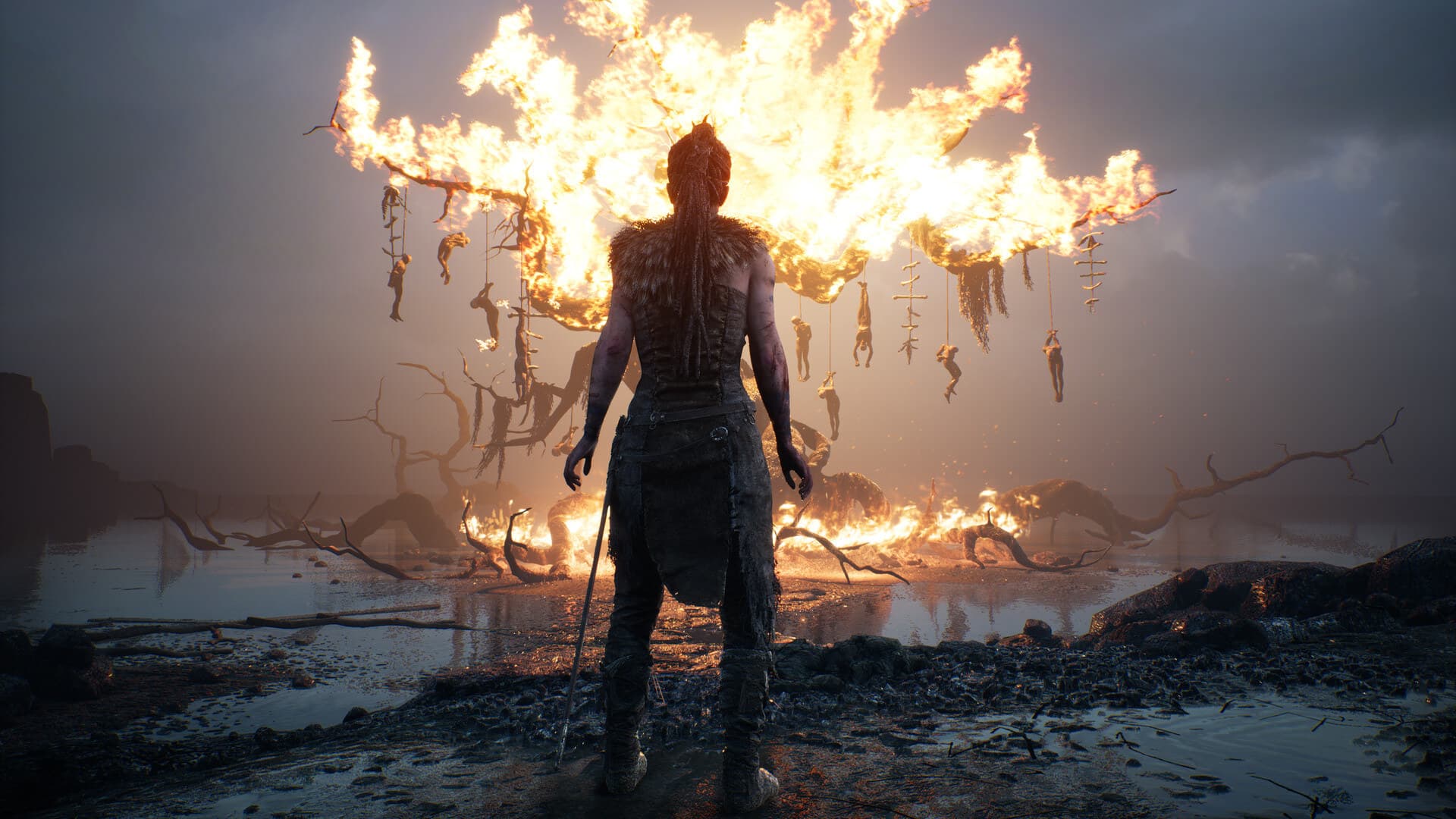
Hellblade: Senua's Sacrifice came out on 8 August 2017, and on 12 August 2025 its sequel, Senua's Saga: Hellblade II, reached PlayStation 5. Each new player meets the same thing early on: a carved totem in the mist, ringed with angular letters, and Druth's voice telling an old Norse story. Then comes the question.
Partly. The runes around Hellblade's Lorestones are real Elder Futhark letters, used as a cipher for an English sentence. The alphabet is genuine. The language is not.
That puts Hellblade in a small club with Valheim and God of War. What makes it worth its own answer is that Ninja Theory hid a whole sentence in those rings, and you can read it yourself with a futhark chart in about five minutes. Decode it letter by letter and the cipher tells you exactly who wrote it: an English speaker, not a Viking.
What is a rune in Hellblade?
In Hellblade a rune is a carved shape you find, not a spell you cast. It appears in two places: on the rune doors, where one shape locks the way forward, and in the rings around the 44 Lorestones, where the letters spell a hidden message. Neither gives Senua a power.
The doors work through focus. A door shows one shape. You walk the area until scenery lines up into it from the right spot (two trees with a cross behind them, a mask and its shadow), then focus and the door opens. Fan transcriptions of the door runes produce strings with no meaning, so the doors are keys, not words.
The Lorestones are where the writing is. Each is a carved totem, and when Senua focuses on it Druth tells one Norse tale. Find all 44 and the game plays an extra scene before the final fight. The ring of runes cut around each stone is easy to walk past.
How do you decode the Lorestone message?
Swap each rune for one Latin letter and read clockwise from the top. Dots mark the breaks between words. Players on the Steam forum and in fan guides who did this all arrived at the same ten words.
| Runes | Letters |
|---|---|
| ᛋᛖᛖᚲ | SEEK |
| ᚺᛖᛚᚨᛋ | HELAS |
| ᛏᚱᚢᛏᚺ | TRUTH |
| ᛁᚾ | IN |
| ᛗᛁᚱᚱᛟᚱ | MIRROR |
| ᚷᛟᛞᛋ | GODS |
| ᛒᛖᛏᚱᚨᛃ | BETRAY |
| ᚢᛋ | US |
| ᚢᚾᛗᚨᛋᚲ | UNMASK |
| ᚠᛖᚨᚱ | FEAR |
SEEK HELAS TRUTH IN MIRROR GODS BETRAY US UNMASK FEAR. It reads like a warning about where the story is going: Hela is the goddess Senua has come to face.
Count the runes and you get a second surprise. Four, five, five, two, six, four, six, two, six, four: the sentence is exactly 44 runes long, the same as the number of Lorestones.
Every letter in it is a real Elder Futhark rune with its real value. ᚲ is kenaz, K. ᛏ is tiwaz, T. ᚠ is fehu, F. Nothing is invented and nothing is flipped. The sentence uses 18 of the 24 runes, and you could check every one against a museum label.
Why does TRUTH take five runes?
Because the cipher copies English spelling, not English sound. Three details give it away.
TRUTH is written ᛏᚱᚢᛏᚺ: T, R, U, T, H. The Elder Futhark has one letter for the sound at the end of that word, thurisaz, ᚦ. A carver writing by ear would cut ᛏᚱᚢᚦ, four runes. Writing T and H separately only makes sense if you start from the printed English word. Thurisaz is one of the six runes the sentence never uses.
MIRROR keeps its double R and SEEK its double E. Runic carvers normally wrote a doubled sound once, often even where one word ended and the next began with the same letter. Doubling is a habit of the page.
BETRAY ends in ᛃ, jera, whose sound is the y in "year". This one choice is faithful to sound, and it is also the only option: the futhark has no Y.
None of this is a mistake. It is how a cipher works: one sign for one printed letter. The futhark itself was never a cipher. It was a way to write the sounds of a spoken language, and its carvers spelled by ear. Hellblade uses real letters the way a typewriter would, and a carver of Senua's time would have spelled exactly these three words differently.
Are there runes in Hellblade II?
Yes, and they work differently. Senua's Saga: Hellblade II, released on 21 May 2024, moves Senua to Viking-age Iceland and turns the rune door into a perspective puzzle. A barrier shows a rune. You find vantage points where posts, planks and bodies on stakes line up into that shape, and focus. The first such puzzle, in a ruined settlement, needs three runes.
Guides identify one of those three as an algiz shape (ᛉ), a T with a fork. That shape lives in both rune rows: it is algiz in the Elder Futhark, and in the Younger Futhark the same fork stands for maðr, "man". Ninja Theory has not said which alphabet the sequel draws on, and nobody has published a decoded message from it, so we do not claim one.
The Lorestones also return as the Lorestangir, 18 carved posts that each play a piece of lore. They carry the tales, not a documented cipher.
Hellblade runes vs. the Elder Futhark
| Feature | Hellblade (2017) | Elder Futhark |
|---|---|---|
| What one sign is | A letter standing for one printed English letter | A letter with a sound, a name and a meaning |
| How many | 18 used in the hidden sentence | 24 |
| Language written | Modern English | Proto-Norse and other early Germanic tongues |
| How words are spelled | By English spelling: TRUTH as T, R, U, T, H | By sound: one rune for th |
| Can it be read? | Yes, with a futhark chart | Yes, once you learn the letters |
| In use | Since 8 August 2017 | Roughly 150 to 800 CE |
The real runes, briefly
The Elder Futhark is the oldest runic alphabet: 24 letters in three rows of eight, used by Germanic peoples from roughly 150 to 800 CE and cut into wood, bone, metal and stone. Each letter has a sound, a name and a meaning. Fehu is cattle and wealth, uruz the wild ox, thurisaz the giant.
In Norse tradition the runes came to Odin through sacrifice, nine nights hanging on Yggdrasil. People used them to write names and memorials, and also as charms, combined into bindrunes and sigils to hold a focused intent. Reading them for guidance is a practice that continues today.
Why does a Pict carry Norse runes?
Because Hellblade is a Norse story seen through outside eyes. Senua is a Pict from Orkney in the late 8th century, and the Norsemen are the raiders who killed her lover Dillion. Everything she knows of their gods she learned from Druth, a former slave of the Norsemen whom Ninja Theory based on Findan, an Irish Celt taken by Norse raiders.
That framing earns the real letters. Helheim, Surtr and Garm come from the Eddas, Hela is the game's name for the goddess Hel, and the runes come from the same people. The date adds a quiet irony: the late 8th century is exactly when Scandinavians were cutting the futhark from 24 letters down to the 16 of the Younger Futhark. Senua's Lorestones carry the old row at the moment it was being retired, and a Modern English sentence that would not exist for another thousand years.
Want runes you can actually read?
Hellblade gives you 44 real runes and one sentence. The Elder Futhark gives you the same 24 letters with their sounds and meanings attached, and you can learn them one at a time.
The easiest way in is to draw one. You can cast a free rune reading in your browser right now, using the genuine Elder Futhark and their traditional meanings, with a quick single draw for a fast question or a fuller spread for something weightier. If you would rather build the habit slowly, pull a rune of the day each morning, or read how online rune readings work first. The rest of the series is on the runes in games hub, including Tunic, whose invented script writes English sounds instead of spelling, and Ultima, which used the futhark as an English cipher in 1981.
If you came here from Assassin's Creed Valhalla, its hidden runes are the opposite of Senua's: Old Norse, not English, and in the 16-letter Younger Futhark a raider of 873 would really have used. They sat on the game's website, not in the game. See Are the runes in Assassin's Creed Valhalla real?.
Senua spends the game learning not to trust every voice she hears. The runes on her Lorestones are one voice you can check for yourself. , free on iOS, Android, and the web, in English and Russian.
Frequently asked questions
Are the runes in Hellblade real runes?
Partly. The runes around the Lorestones in Hellblade: Senua's Sacrifice are genuine Elder Futhark letters, the real 24-character Germanic alphabet. But they spell modern English, letter for letter, not Old Norse. Decoded, they read SEEK HELAS TRUTH IN MIRROR GODS BETRAY US UNMASK FEAR. The letters are real; the language and the spelling behind them belong to the game.
What do the Lorestone runes in Hellblade say?
Players who decoded the rings of runes around the Lorestones read a ten-word English sentence: SEEK HELAS TRUTH IN MIRROR GODS BETRAY US UNMASK FEAR. It is written in Elder Futhark letters, read clockwise from the top, with dots marking the breaks between words. It points ahead to the final confrontation with Hela, and it is 44 runes long, the same number as the Lorestones.
How many Lorestones are in Hellblade: Senua's Sacrifice?
Forty-four. Each Lorestone is a carved totem that, when Senua focuses on it, plays a Norse tale told by her dead mentor Druth. Finding all 44 unlocks an extra cutscene before the final battle. The rings of runes carved around the stones are where the hidden English sentence is written, in the genuine Elder Futhark.
What runic alphabet does Hellblade use?
The Lorestones use the Elder Futhark, the 24-letter rune row used from roughly 150 to 800 CE. The hidden sentence needs 18 different runes from it. The six it never uses are thurisaz, wunjo, eihwaz, perthro, algiz and ingwaz. Hellblade II's perspective puzzles also show rune shapes, but Ninja Theory has not said which row those come from.
How do you decode the runes in Hellblade?
Swap each rune for one Latin letter using an Elder Futhark chart: ᛋ is S, ᛖ is E, ᚲ is K, ᚺ is H, ᛚ is L, ᚨ is A, ᛏ is T, ᚱ is R and so on. Read each ring clockwise from the top. Because the cipher follows English spelling, the words come out exactly as you would type them, including the double R in MIRROR.
Why is TRUTH spelled with five runes in Hellblade?
Because the cipher copies English spelling, not English sound. TRUTH is written ᛏᚱᚢᛏᚺ, with T and H as two runes. The Elder Futhark has a single letter for that sound, thurisaz (ᚦ), and a real carver would have used it: ᛏᚱᚢᚦ. The five-rune version is the clearest sign that the sentence was composed in English and then transliterated.
Do the rune doors in Hellblade spell anything?
Not as far as anyone has shown. Each rune door shows one shape, and Senua opens it by finding that shape in the scenery with her focus, for example by lining up two trees and a cross behind them. Fan transcriptions of the door runes produce strings with no clear meaning, so they work as keys, not words. Only the Lorestone rings carry a message.
Are there runes in Hellblade 2?
Yes. Senua's Saga: Hellblade II, released on 21 May 2024, uses rune perspective puzzles: a barrier shows a rune, and you find vantage points where scenery lines up into that shape. Guides identify one as an algiz shape. Its 18 Lorestangir posts carry lore, but no decoded sentence like the first game's has been documented.
What are the Lorestangir in Hellblade 2?
The Lorestangir are the sequel's version of the Lorestones: 18 carved posts across the first five chapters, each of which plays a piece of lore when Senua focuses on it. Finding all 18 unlocks the Tales of Midgard achievement. They continue the first game's idea of storytelling through carved wood and stone set in Viking-age Iceland.
Is Hellblade based on real Norse mythology?
Yes, through a Pictish lens. Senua is a Pict from Orkney in the late 8th century, travelling into Helheim to free the soul of her lover Dillion. She faces Norse figures from the Eddas, including Hel (here called Hela), the fire giant Surtr and the hound Garm. Her guide to those myths is Druth, a former slave of the Norsemen.
Who is Druth in Hellblade?
Druth is Senua's mentor, a man who had been a slave of the Norsemen and learned their legends. He is dead when the game begins, and his voice narrates the Lorestones. Ninja Theory based him on Findan, an Irish Celt taken captive by Norse raiders. His name comes from a Celtic word for one who speaks the words of gods.
Would a Viking have been able to read the Hellblade runes?
He would recognise the letters but not the message. The runes are real, yet the sentence is Modern English, which would not exist for centuries. He would also find the spelling strange: two runes for the th sound where he had one, and doubled letters that runic carvers normally wrote once. Some of the letters were already going out of use by 800.
What is the Elder Futhark?
The Elder Futhark is the oldest runic alphabet: 24 letters used by Germanic peoples from roughly 150 to 800 CE, carved on wood, bone, metal and stone. Each rune has a sound, a name and a meaning, such as fehu for cattle and wealth. Around 800 it was cut down to the 16-letter Younger Futhark that the Vikings used.
Where can I try a real rune reading online?
You can cast a free rune reading in your browser with the Way of the Runes rune-reading tool. It uses the genuine 24 Elder Futhark runes and their traditional meanings, with quick single draws for a fast question and fuller spreads for something weightier, and a full description for every rune. It works on any device, in English and Russian.
Which rune are you?
Seven questions, about a minute, and you get one of the 24 Elder Futhark runes. The scoring is shown as you answer. Free, no signup.