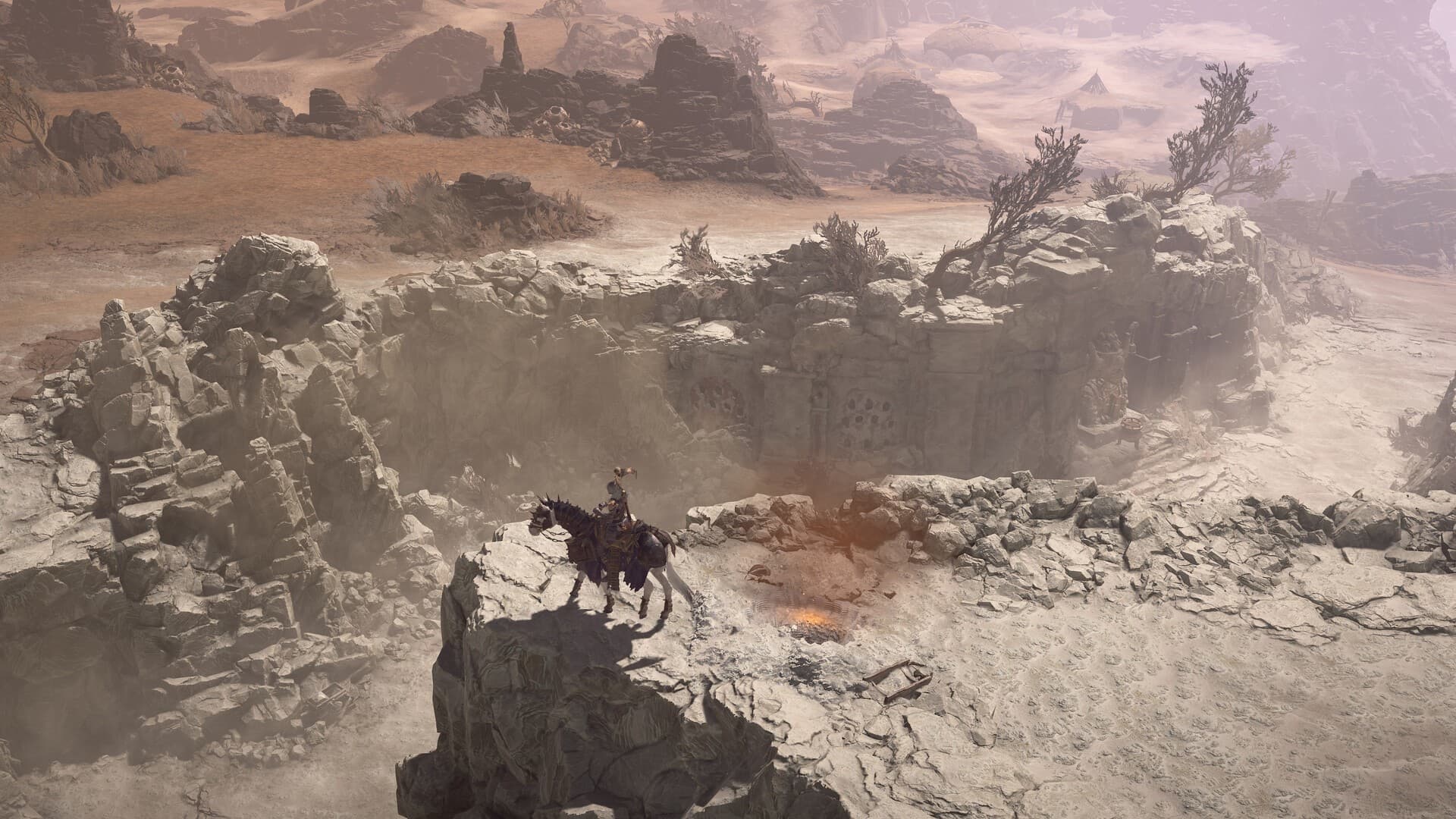
Diablo IV Season 15, Season of Hell's Legacy, started on 15 September 2026 and brought twelve Diablo II rune names into Sanctuary, Tir, Ber and Ist among them. Players who skipped the Vessel of Hatred expansion are opening the Socketables tab for the first time, finding stones called Cem, Bac and Ohm, and asking whether any of this is real.
No. The runes in Diablo IV are words in a tiny spell language, not letters. Each one carries a whole meaning, and none of them carries a sound.
Diablo II turned runes into passwords. Diablo IV did something stranger: it gave them grammar. Every runeword is a sentence with two slots, a "when" and a "then", and the item even names the result by joining the two words: Bac and Jah make BacJah. Diablo IV built a grammar for runes and left out the alphabet.
What is a rune in Diablo IV?
A rune in Diablo IV is a socketable stone that does nothing on its own. Runes arrived with Vessel of Hatred on 8 October 2024 and drop only for players who own it. There are two kinds, and a runeword needs one of each in the same two-socket item.
- Runes of Ritual set a condition. Meet it and the rune pays you Offering, a hidden counter. Cem pays 75 each time you Evade. Bac pays 50 for every 5 metres you travel.
- Runes of Invocation spend Offering. When the counter reaches their price, they fire. Ohm costs 600 and casts the Barbarian's War Cry, raising your damage by 7.5% for 6 seconds.
The rules are strict. Runewords fit only a helm, chest armour, legs or a two-handed weapon. A character wears at most two, cannot repeat a rune, and cannot mix gems and runes in one item. Runes drop as Magic, Rare or Legendary, and the same rune gets stronger with rarity. Maxroll's runeword table, updated on 19 September 2026, lists 18 Runes of Ritual and 26 Runes of Invocation: 44 in all.
Is a Diablo IV runeword a sentence?
In structure, yes. A runeword is a conditional clause: when the Ritual happens, then the Invocation fires. Maxroll's guide calls the two halves "cause" and "effect". Offering is the joint between them, the part of the sentence that says "every time this adds up".
| Runeword | When (Ritual) | Pays | Then (Invocation) | Costs | Reads as |
|---|---|---|---|---|---|
| CemOhm | Cem: you Evade | 75 | Ohm: War Cry, +7.5% damage | 600 | Every 8 evades, shout |
| BacJah | Bac: you travel 5 metres | 50 | Jah: next Evade becomes Teleport | 350 | Every 35 metres, blink |
| TamVex | Tam: you cast a Core Skill | 25 | Vex: +1 to all Skills for 10 seconds | 100 | Every 4 Core Skills, rank up |
| ZanNer | Zan: you cast an Ultimate | 200 | Ner: Concealment for 5 seconds | 600 | Every 3 Ultimates, vanish |
| YaxThul | Yax: you drink a Healing Potion | 200 | Thul: Frost Nova | 250 | Every 2 potions, freeze the room |
Read the right-hand column and you are reading sentences. That is more than Diablo II ever managed. There, a runeword was an ordered string of stones that meant nothing until the whole recipe matched. Here, every rune means something alone, and the game has word classes: two Ritual runes will not combine, just as two "when" clauses with no "then" make no sentence.
The vocabulary even borrows from neighbours, the way real languages do. Ohm lends you the Barbarian's War Cry, Thul and Jah the Sorcerer's Frost Nova and Teleport, Kry the Spiritborn's Vortex, Kel the Paladin's Rally and Prid the Warlock's Dark Prison. A Necromancer can shout like a Barbarian if the sentence says so.
If runewords have grammar, why are they not writing?
Because Diablo IV starts at the wrong end. Writing works upward: a letter stands for a sound, letters spell words, and words build sentences. Diablo IV begins at the word. Cem means "when you Evade", and no part of the stone stands for a sound you could reuse anywhere else.
That choice puts a ceiling on what the language can say. With 18 Ritual words, 26 Invocation words and one sentence pattern, Diablo IV can form 468 runewords, 18 times 26, and not one more. Add a new idea and Blizzard has to add a new stone, which is exactly what Season 15 did.
The Elder Futhark has no ceiling. Its 24 letters spell any word in any Germanic language, because each sign is a sound first. A real rune does carry a name and a meaning as well: Fehu is the F sound and the word for cattle and wealth. Diablo IV kept the meaning and dropped the sound, and the sound is the part that lets 24 signs write everything.
Are Diablo IV runes the same as Diablo II runes?
Some of them now are. The Lord of Hatred expansion brought back the Horadric Cube on 28 April 2026, and Season 15 used it for a second rune system beside the first. Its twelve runes carry Diablo II names: Amn, Ber, Eth, Ist, Ith, Lo, Mal, Ort, Ral, Sol, Tal and Tir. They feed 19 classic runewords, made by putting a Common, white base item and the right runes into the Cube.
The recipes are Diablo II's. Enigma is Jah, Ith and Ber in chest armour. Call to Arms is Amn, Ral, Mal, Ist and Ohm. The Cube even rebuilds the old rarity ladder: three Tir make an Eth, and higher up two Mal and a Flawless Amethyst make an Ist. So Diablo IV now runs both ideas at once, the two-word sentence in your sockets and the Diablo II password in your Cube.
One name kept its job for 25 years. Diablo II's Tir gave 2 mana after each kill. Diablo IV's Tir gives 2 Primary Resource on kill for 8 seconds, stacking up to 8. It still does not give you the letter T.
Diablo III, released on 15 May 2012, took a third route. Its skill runes were not items at all: you unlocked them by levelling, five per skill, and each one reshaped a skill you already had. The Wizard's Magic Missile could become Charged Blast, Glacial Spike, Split, Seeker or Conflagrate. Across three games, a Diablo rune has been a password, an adverb and a sentence. It has never been a letter.
Diablo IV runes vs. the Elder Futhark
| Feature | Diablo IV (2023) | Elder Futhark |
|---|---|---|
| What one sign is | A word: a condition or an effect | A letter with a sound, a name and a meaning |
| How many | 44 (18 Ritual, 26 Invocation) | 24 |
| How signs combine | Exactly two, one of each kind | As many as a word needs, in any order |
| How many messages | 468 possible runewords | Unlimited |
| Does a sign have a sound? | No | Yes |
| Can it be read? | No, nothing is encoded | Yes, once you learn the letters |
| In use | Since 8 October 2024 | Roughly 150 to 800 CE |
The real runes, briefly
The real runes are an alphabet. The Elder Futhark has 24 letters, used from roughly 150 to 800 CE, carved into wood, bone, metal and stone. Each letter has a sound, a name and a meaning: Tiwaz is T and the god Tyr, Sowilo is S and the sun, Berkano is B and the birch.
Diablo IV's Tir and Sol come from those names, by way of Diablo II. Tir is the Old English name for Tiwaz in the Anglo-Saxon futhorc. Sól is the Old Norse name for Sowilo in the 16-letter Younger Futhark of the Viking Age. Ist and Ber sound like Isa and Berkano, but those are near misses, not proven borrowings.
In Norse tradition Odin wins the runes by hanging nine nights on Yggdrasil. From there they served as writing, charms and protections, combined into bindrunes and sigils, and read for guidance in a practice that continues today.
Why Sanctuary has no room for real runes
Diablo IV is set in Sanctuary, a world made by rebel angels and demons. Its villain is Lilith, daughter of Mephisto, and its expansions open the jungles of Nahantu and the Skovos Isles, where Lord of Hatred adds the Paladin and the Warlock. There is no Odin, no Yggdrasil and no Germanic people to carve a futhark.
Blizzard needed something else from its runes: a way to let one class borrow another's skills, tuned by numbers it can patch every season. A grammar of conditions and effects does that well. An alphabet would not have done it at all.
Want runes you can actually read?
Diablo IV gives you 44 words and one sentence to put them in. The real futhark gives you 24 letters, and with them you can write any sentence at all, including the questions you bring to a reading.
The easiest way in is to draw one. You can cast a free rune reading in your browser right now, using the genuine Elder Futhark and their traditional meanings. Start with Tiwaz, the rune behind Tir, pull a rune of the day each morning, or read how online rune readings work first. The rest of the series is on the runes in games hub. Diablo II explains the password version, The Witcher 3 sells runewords through an enchanter, and Valheim is the one game that uses the real futhark.
Your runeword fires every eighth Evade and says the same thing every time. A real rune says something new with every question you ask it. , free on iOS, Android, and the web, in English and Russian.
Frequently asked questions
Are the runes in Diablo IV real runes?
No. Diablo IV's runes are socketable stones that each carry a whole game meaning, such as 'when you Evade' or 'cast Frost Nova'. None of them stands for a sound, so they cannot spell anything in any language. A few names, like Tir and Sol, echo real rune names through Diablo II, but the stones do not work as letters.
How do runewords work in Diablo IV?
A runeword is one Rune of Ritual and one Rune of Invocation socketed into the same item with two sockets. The Ritual rune sets a condition and pays Offering each time you meet it. When the Offering reaches the Invocation rune's price, its effect fires. Cem plus Ohm, for example, casts War Cry after every 8 evades.
What is Offering in Diablo IV?
Offering is the hidden counter that links the two halves of a runeword. The Ritual rune adds to it, and the Invocation rune spends it. Cem adds 75 for each Evade, and Ohm needs 600, so the pair fires every eighth Evade. Any Offering beyond the price is Overflow, which some Invocation runes turn into a longer or stronger effect.
What is the difference between Ritual and Invocation runes?
A Rune of Ritual is the 'when': travel 5 metres, drink a potion, cast an Ultimate, Evade. A Rune of Invocation is the 'then': a buff, a resource refill, or another class's skill such as the Sorcerer's Frost Nova or the Barbarian's War Cry. A runeword needs exactly one of each, and two runes of the same kind will not combine.
How many runes are in Diablo IV?
Maxroll's runeword table, updated on 19 September 2026, lists 44: 18 Runes of Ritual and 26 Runes of Invocation. Twelve of them arrived with Season 15 and are named after Diablo II runes. Each rune drops in Magic, Rare or Legendary rarity, and the higher the rarity, the stronger the same rune's effect.
Where can you socket runes in Diablo IV?
Only in items with two sockets: a helm, chest armour, legs or a two-handed weapon. Both runes of a runeword must sit in the same item, and an item cannot hold gems and runes at once. A character can wear at most two runewords, and cannot use the same rune twice or put the same Ritual rune in both.
How do you get runes in Diablo IV?
Runes drop only for players who own the Vessel of Hatred expansion. Maxroll lists World Bosses, the Kurast Undercity with a Tribute of Harmony, Helltide chests and Tree of Whispers rewards as common sources. You can also take three runes of the same name to the Jeweler to craft a different random rune, sometimes of a higher rarity.
What are the new runes in Diablo IV Season 15?
Season 15, Season of Hell's Legacy, started on 15 September 2026 and added twelve runes named after Diablo II: Amn, Ber, Eth, Ist, Ith, Lo, Mal, Ort, Ral, Sol, Tal and Tir. Five are Ritual runes and seven are Invocation runes. They also feed 19 classic runewords crafted in the Horadric Cube, including Enigma and Call to Arms.
How do you make Enigma in Diablo IV?
Put a Common, white chest armour and the runes Jah, Ith and Ber into the Horadric Cube and transmute them. That is the same three-rune recipe Enigma uses in Diablo II, in the same order. An Ancestral white base gives an Ancestral Enigma. The Cube itself comes from the Lord of Hatred campaign, released on 28 April 2026.
Are Diablo IV runes the same as Diablo II runes?
Partly. The two-rune Ritual and Invocation system is new to Diablo IV and has no Diablo II equivalent. The Season 15 runes reuse Diablo II names and recipes, and some keep their old job: Diablo II's Tir gave 2 mana per kill, and Diablo IV's Tir gives 2 Primary Resource on kill, stacking up to 8.
What were skill runes in Diablo III?
Diablo III, released on 15 May 2012, turned runes into skill modifiers rather than items. You unlocked them by levelling, and each skill had five. The Wizard's Magic Missile could become Charged Blast, Glacial Spike, Split, Seeker or Conflagrate. A Diablo III rune changed how a skill behaved, the way an adverb changes a verb.
Are Diablo IV runes based on the Elder Futhark?
No. The Elder Futhark is a 24-letter alphabet in which every sign stands for a sound. Diablo IV's 44 runes stand for conditions and effects, and they combine in only one pattern, one of each kind. Tir and Sol echo real rune names, Tiwaz and Sowilo, but only as names inherited from Diablo II.
Is Diablo IV based on Norse mythology?
No. Diablo IV is set in Sanctuary, a world made by rebel angels and demons. Its villain is Lilith, daughter of Mephisto, and its expansions add the jungles of Nahantu and the Skovos Isles. There is no Odin, no Yggdrasil and no Germanic people carving a futhark. The mythology is Blizzard's own, built over three decades.
Where can I try a real rune reading online?
You can cast a free rune reading in your browser with the Way of the Runes rune-reading tool. It uses the genuine 24 Elder Futhark runes and their traditional meanings, with quick single draws for a fast question and fuller spreads for something weightier, and a full description for every rune. It works on any device, in English and Russian.
Which rune are you?
Seven questions, about a minute, and you get one of the 24 Elder Futhark runes. The scoring is shown as you answer. Free, no signup.