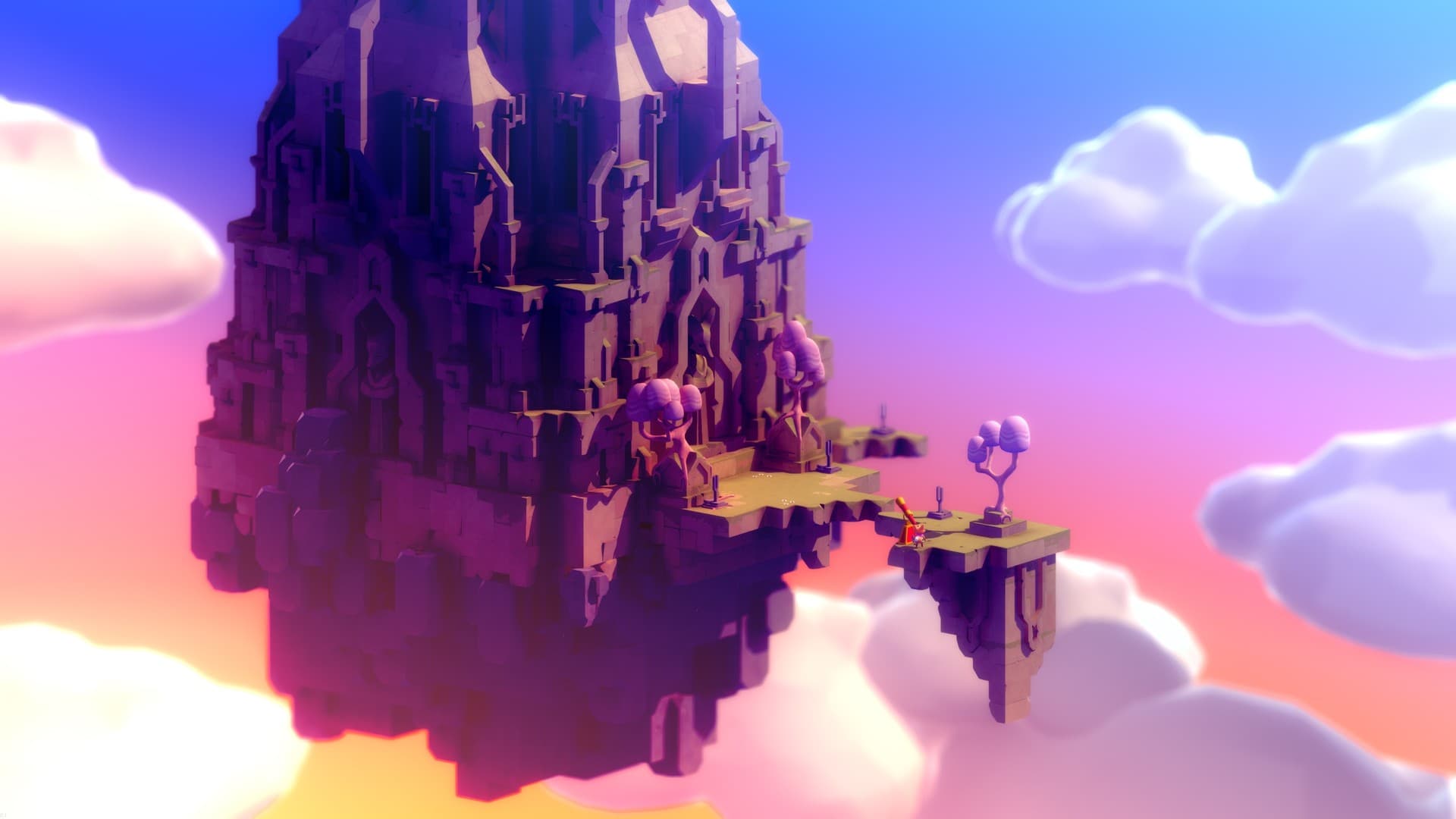
Tunic opens with a small fox on a beach, a sword it has not found yet, and a world where every sign, shop label and manual page is written in angular glyphs nobody can read. The game was built that way on purpose. By the end, most players have stared at those hexagons long enough to ask the question.
No. The runes in Tunic are Trunic, a script invented for the game, not the Elder Futhark. No glyph is a real rune, and nothing in it comes from any historical alphabet.
But Tunic is not like the rest of this series. Valheim, Fable and Minecraft all hide English behind their symbols, one letter at a time. Tunic hides English sounds, which is exactly what the real runes wrote. Trunic has fake shapes and the real method.
What are the runes in Tunic?
The "runes" are the game's writing. Tunic, made by Andrew Shouldice and released by Finji on 16 March 2022 for Windows, macOS and Xbox, then on Switch and PlayStation on 27 September 2022, replaces almost every word of text with a constructed script. Players named it Trunic, from Tunic and runic.
Shouldice began the game in February 2015, and the script came from a childhood memory: game manuals he read before he had the context to understand them. He wanted text that clearly meant something and could not be read. So the game hands you instruction manual pages as collectibles, full of drawings, maps, diagrams and handwritten notes, with the explanations locked behind Trunic.
You never have to read it. The pictures carry the puzzles. That design won Tunic BAFTA awards for Artistic Achievement and Debut Game. But the text is not decoration. Every line is real English, and it can all be read.
Why Trunic works like a real rune row
Most game alphabets on this site are ciphers. Valheim swaps each English letter for an Elder Futhark letter. Minecraft swaps each letter for a Standard Galactic glyph. Fable's map runes do the same. Decode them and you get English spelling, silent letters and all: knight still starts with a k.
Trunic does not spell. It writes what you hear. The clearest proof came from the Lingoblog linguist who analysed it: one glyph stood for both eye and I. A cipher would write those two words differently, because they are spelled differently. A sound script writes them the same, because they sound the same. The same analysis found the script follows Shouldice's own Canadian pronunciation closely enough to show dialect traits, which only happens when the writing tracks a voice rather than a dictionary.
That is how the Elder Futhark worked. Each of its 24 letters was a sound first. The alphabet is even named after sounds, its first six: f, u, th, a, r, k. Carvers cut what they said, not a fixed spelling, because no fixed spelling existed. In the Viking Age the row shrank to the 16 letters of the Younger Futhark, so one letter had to cover several sounds, and carvers kept writing by ear anyway.
So the honest verdict has two halves. As objects, Tunic's runes are invented. As a method, they are the most rune-like writing in any game we have covered.
How do you read Trunic?
Each Trunic glyph is built on the same frame: a hexagon cut by a horizontal line through its middle, with strokes switched on or off around and inside it. A glyph carries a consonant, a vowel, or one of each, and the parts always do the same job.
| Part of the glyph | What it tells you |
|---|---|
| Outer strokes of the hexagon | The vowel |
| Inner strokes | The consonant |
| No circle underneath | Say the consonant first, then the vowel |
| Small circle underneath | Say the vowel first, then the consonant |
| Unbroken middle line | These glyphs are one word |
| Gap in the middle line | A new word starts |
To read a word, work left to right:
- Find where the middle line breaks. That gives you the word boundaries.
- In each glyph, match the inner strokes to a consonant and the outer frame to a vowel.
- Check for the circle and put the two sounds in the right order.
- Say the glyphs aloud in sequence and listen. You are hearing English, so spell it however English spells it.
One widely used fan chart, the Tunic rune teacher, lists 24 consonant sounds and 18 vowel sounds, including r-coloured vowels such as ar, eer and ore. Two consonants are both written th in English, because English has a voiced th (this) and a voiceless one (thin), and Trunic gives each its own shape. That alone shows you it is mapping sounds, not letters.
Packing a consonant and a vowel into one sign makes Trunic look less like the futhark and more like Korean Hangul, whose letters stack into syllable blocks. It is a clever design. It is also nothing a Germanic carver ever did.
Who cracked the Tunic language?
Players did, fast. A Reddit user called oposdeo posted a full sound chart to the Tunic subreddit, and Shacknews reported it on 4 April 2022, less than three weeks after launch. Oposdeo worked the way a real runologist works, from context: "I've translated maybe 10 guidebook pages to find all these symbols, so I'm quite confident in them."
The game kept one more layer back. In October 2022 audio designer Kevin Regamey showed that some of the music speaks Trunic too, with notes on a pentatonic arpeggio standing for its sounds. Fans call it Tuneic. Defeat the Heir and the music says heir to the heir. Cast the Seeker spell and it says this way, this way, fox friend. Regamey called this kind of detail "content for no one", hidden because the team liked making it.
A language decoded from a handful of pages and a soundtrack that talks: that is the closest a game has come to what reading real runes feels like.
Tunic runes vs. the Elder Futhark
| Feature | Tunic (2022) | Elder Futhark |
|---|---|---|
| What one sign is | A syllable: a consonant, a vowel, or both | A letter with a sound, a name and a meaning |
| How many | 24 consonants and 18 vowels in one fan chart | 24 |
| What it records | Spoken English | Early Germanic speech |
| Built from | Straight strokes on a hexagonal frame | Straight strokes, cut into wood, bone, stone and metal |
| Words joined by | One line through the middle | Nothing; letters stand apart |
| Can it be read? | Yes, by sound | Yes, once you learn the letters |
| In use | Since 16 March 2022 | Roughly 150 to 800 CE |
The real runes, briefly
The Elder Futhark is the oldest runic alphabet: 24 letters used by Germanic peoples from roughly 150 to 800 CE. Each letter has a sound, a name and a meaning. Fehu is f and means cattle and wealth, Uruz is u and the wild ox, Ansuz is a and a god. The letters are cut almost entirely from straight strokes, so every one can be told apart by shape alone. Trunic shares that look, which is why it reads as runic at a glance.
What the real runes carry, and Trunic does not, is everything beyond the sound. In Norse tradition, Odin wins the runes by hanging nine nights on Yggdrasil, pierced by his own spear. From there they served as charms and protections, were combined into bindrunes and sigils to hold a focused intent, and were read for guidance in a practice that continues today.
Why the fox's world has no room for real runes
Tunic's world is its own invention: a fox, a sword, an Overworld of ruins, the East Forest, the Ruined Atoll, the Quarry, the Rooted Ziggurat and the Cathedral. There is no Odin, no Asgard, no Eddas, and the game never claims a culture behind its script. The runic look is a mood, not a reference.
Given that, borrowing the futhark would have been the wrong choice. Real runes would have been readable to anyone who knows them and would have dragged Scandinavia into a world that has nothing to do with it. Shouldice needed a script that felt ancient, stayed unreadable for a while and paid off when cracked. Writing English by sound did all three.
Want runes you can actually read?
Tunic teaches the hardest idea in runic writing without saying so: a sign is a sound, and a page of signs is a voice. The Elder Futhark works the same way, with 24 letters instead of 42 sounds, and its letters carry meanings that are still read today.
The easiest way in is to draw one. You can cast a free rune reading in your browser right now, using the genuine Elder Futhark and their traditional meanings, with a quick single draw for a fast question or a fuller spread for something weightier. If you would rather build the habit slowly, pull a rune of the day each morning and learn the futhark one sign at a time, or read how online rune readings work first. The rest of the series is collected on the runes in games hub.
If you liked cracking Tunic's manual, the real futhark is the same puzzle with older stakes, and it has been waiting about eighteen centuries. , free on iOS, Android, and the web, in English and Russian.
Frequently asked questions
Are the runes in Tunic real runes?
No. The runes in Tunic are Trunic, a script Andrew Shouldice invented for the game in place of written English. No sign comes from the Elder Futhark or any historical alphabet. Trunic does work the way real runes worked, though: every glyph writes sounds of speech, so a player who learns the sound values can read the whole game, manual and signs included.
What is Trunic?
Trunic is the fan name for the writing system in Tunic, a blend of Tunic and runic. Each glyph sits on a hexagonal frame. The outer strokes give a vowel, the inner strokes give a consonant, and a small circle under the glyph reverses their order. A line through the middle of the glyphs joins them into one word.
How do you read Trunic?
Read one glyph at a time, left to right. Take the inner strokes as a consonant and the outer frame as a vowel, then say the consonant first unless a small circle sits under the glyph, in which case say the vowel first. Glyphs sharing one unbroken middle line belong to the same word. Sound the result out and listen for English.
What language is Tunic written in?
English. Every line of Trunic in the game, from the instruction manual pages to the signs in the world, is English written by sound rather than by spelling. The linguist behind the Lingoblog analysis of the script notes that it follows the creator's own Canadian pronunciation closely enough to show dialect traits, which only happens when a script records sounds.
How many sounds does Trunic have?
About forty. One widely used fan reference chart, the Tunic rune teacher, lists 24 consonant sounds and 18 vowel sounds, including r-coloured vowels such as ar, eer and ore. Two consonants share the spelling th, because English has a voiced and a voiceless th. A single Trunic glyph combines one consonant with one vowel.
Who created the Tunic language?
Andrew Shouldice, the designer and artist behind Tunic, who began the game in February 2015. He wanted text that clearly meant something but could not be understood, recreating how game manuals felt to him as a child who lacked the context to read them. Tunic was released by Finji on 16 March 2022.
Who decoded Trunic?
A Reddit user called oposdeo published the first full sound chart on the Tunic subreddit within weeks of the game's 16 March 2022 launch. Shacknews reported it on 4 April 2022. Oposdeo worked from the in-game manual and wrote: "I've translated maybe 10 guidebook pages to find all these symbols, so I'm quite confident in them."
Do you need to read Trunic to finish Tunic?
No. Tunic is designed so that the player is not expected to decipher most of its text. The instruction manual pages you collect carry drawings, maps, diagrams and handwritten notes, and those pictures are enough to solve its puzzles. Reading Trunic adds the item names, the lore and a few jokes, but the game never demands it.
Is Trunic based on the Elder Futhark?
No. Trunic borrows the look of runes, straight strokes on a fixed frame, but none of its glyphs is a futhark letter, and its sound values are its own. The Elder Futhark has 24 separate letters, one sound each. A Trunic glyph packs a consonant and a vowel into one sign, a design closer to Korean Hangul syllable blocks.
Does Tunic have a secret audio language?
Yes. Audio designer Kevin Regamey revealed in October 2022 that some of the music speaks Trunic too, with notes on a pentatonic arpeggio standing for its sounds. Fans call it Tuneic. Defeating the Heir plays a phrase that reads heir to the heir, and the Seeker spell plays this way, this way, fox friend.
Why is there a line through the words in Tunic?
The horizontal line through the middle of each glyph is what joins glyphs into words. Every glyph in one word shares a single unbroken line, and a gap in the line marks the space between words. Real runic inscriptions had no such line. Their letters stand apart, each cut as its own sign.
Is Tunic based on Norse mythology?
No. Tunic follows a small fox through an invented, wordless world of ruins, forests, an atoll, a quarry and a cathedral. It has no Norse gods, no Yggdrasil and no Eddas. The runic look of its script is a visual choice that makes the text feel old and unreadable, not a reference to Scandinavia or the Vikings.
How is Tunic different from Valheim's runes?
Valheim uses the real Elder Futhark as a letter cipher: each rune stands for one English letter, so it spells English the way it is written. Tunic invents its own glyphs but records English the way it is spoken. Valheim has the real shapes and a fake method; Tunic has fake shapes and the real method of a sound-based script.
Where can I try a real rune reading online?
You can cast a free rune reading in your browser with the Way of the Runes rune-reading tool. It uses the genuine 24 Elder Futhark runes and their traditional meanings, with quick single draws for a fast question and fuller spreads for something weightier, and a full description for every rune. It works on any device, in English and Russian.
Which rune are you?
Seven questions, about a minute, and you get one of the 24 Elder Futhark runes. The scoring is shown as you answer. Free, no signup.