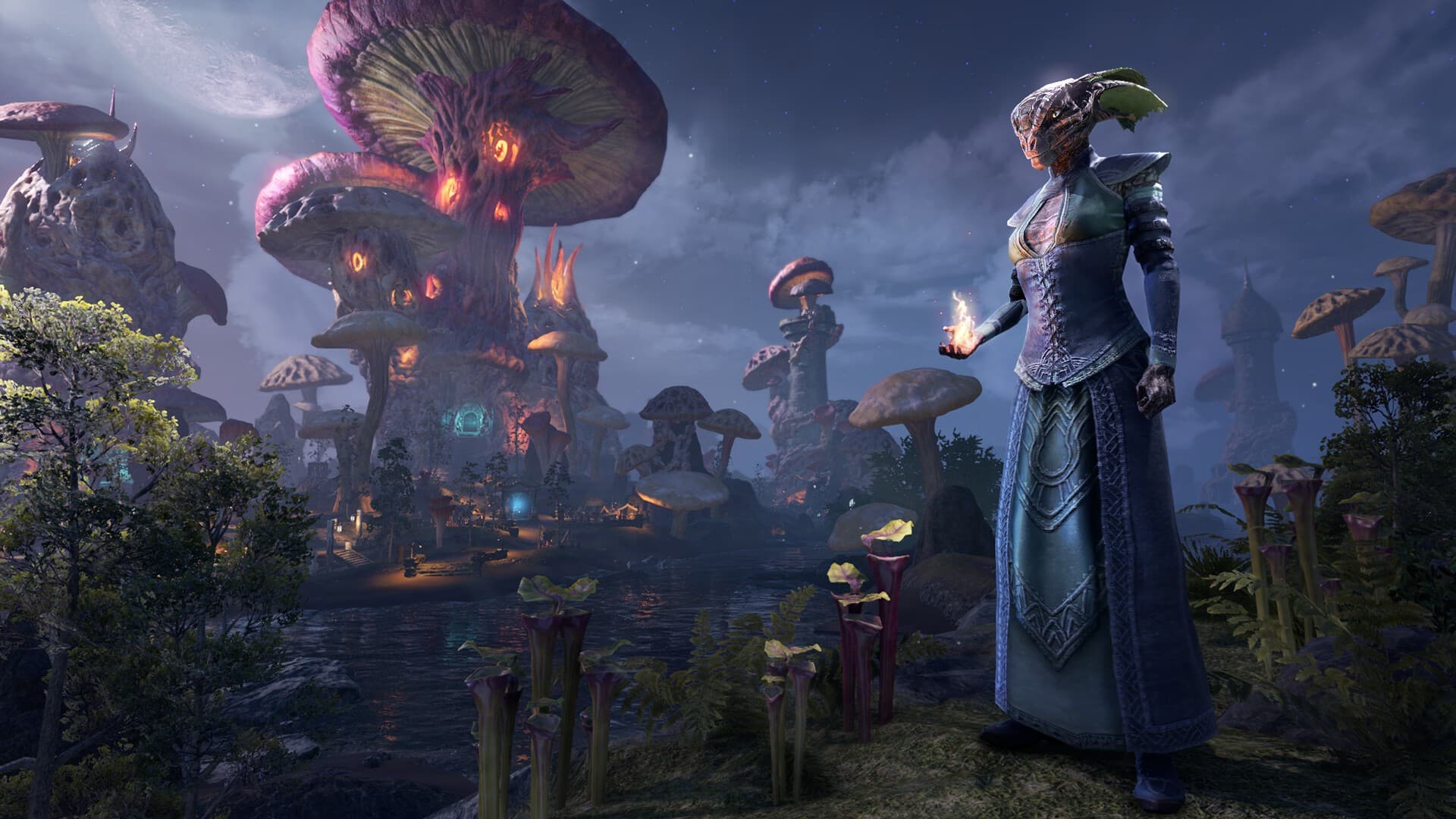
The Elder Scrolls III: Morrowind turns 25 on 1 May 2027, and its island is still open. Since June 2017 The Elder Scrolls Online has let players walk Vvardenfell again, casting spells ringed with sharp Daedric letters, then stopping at an enchanting table to combine three small stones called runestones into a glyph. Two kinds of rune in one game. Is either of them real?
No. The runes in The Elder Scrolls Online are invented: the Daedric script is a cipher for English, and the runestones carry made-up syllables that translate into stat words. Neither is the Elder Futhark.
ESO earns its own answer because it is the one game in this series that makes you translate runes. Every runestone starts as an unknown word, and you learn its meaning by using it. Follow the translations through, though, and every sentence you can build has three words, in one fixed order, and all three describe the item in your hand. Tamriel has an alphabet with no language of its own, and a language with nothing to say.
What is a rune in The Elder Scrolls Online?
A rune in ESO is a runestone, the raw material of the Enchanting craft. Combine three at an enchanting table, one Potency, one Essence and one Aspect, and you get a glyph, which you fix to a weapon, a piece of armour or jewellery. Potency sets the level, Essence the effect and Aspect the quality.
| Group | What it decides | How many | Examples |
|---|---|---|---|
| Potency | The glyph's level, and whether it adds or subtracts | 32: 16 additive, 16 subtractive | Jora, Porade, Jera, Cura, Repora; Jode, Notade, Rede, Itade |
| Essence | The effect: health, magicka, stamina, fire, frost, shock and more | More than 20 | Oko, Makko, Deni, Rakeipa, Dekeipa, Meip |
| Aspect | The quality, from white to gold | 5 | Ta, Jejota, Denata, Rekuta, Kuta |
The split between additive and subtractive is the system's one clever move. Meip with an additive Potency makes a Glyph of Shock for a weapon. With a subtractive Potency, the same stone makes a Shock Resist glyph for jewellery. You gather runestones from nodes across Tamriel, from the Enchanter hireling who mails them to you, or by breaking down old glyphs.
What do the runestone names translate to?
Each runestone translates into one English word, and you learn it by using the stone. A new character sees every runestone as untranslated. Craft a glyph successfully and the game reveals all three of its runes for good, with a bonus of Inspiration, the crafting experience. Jora becomes "Develop". Oko becomes "Health". Ta becomes "Base".
Put those three back together and you have a Trifling Glyph of Health. In translation, the recipe reads "Develop Health Base". That is the longest sentence the runestone language allows. It always has three words, always in the order level, effect, quality. Cura, "Intensify", and Kuta, "Legendary", sit at the top of the scale; Jode, "Reduce", and Itade, "Plunder", on the subtractive side.
The lore goes further than the game. UESP, the main Elder Scrolls wiki, describes a rune-language written in its own syllabic script on the runestones, one group of strokes per syllable, from no known culture in Tamriel. Jo-ra, Po-ra-de, Re-ku-ta: the names do read like strings of syllables. A syllabary, one sign per syllable, is a real kind of writing; Japanese kana work that way. The futhark does not. It gives one letter to each sound.
But a writing system has to write more than its own price list. Real runestones carry names, memorials, boasts and verse. ESO's runestones carry "Develop Health Base".
Is the Daedric alphabet a real runic script?
No. The Daedric alphabet is a substitution cipher for English: one invented sign for each English letter, written left to right. The artist Mark Jackson designed it for An Elder Scrolls Legend: Battlespire, released on 4 December 1997, where the Daedra who seized the Battlespire wrote with it. Morrowind then put it on scrolls and city banners.
Decode one and you get English. A banner in the Morrowind town of Gnisis reads "The thrice sealed house withstands the storm." Oblivion used the script for the Mysterium Xarxes, the book of Mehrunes Dagon, Skyrim for its Ash, Frost and Lightning runes, and ESO for spell effects.
That is the trick behind Minecraft's enchanting table, which writes English in the Standard Galactic Alphabet, and the mirror image of Ultima, which writes English in real futhark letters. Swap the Daedric shapes for Latin ones and nothing else changes. That is the definition of a cipher.
Bethesda did give each letter a name, as the futhark does. Ayem is A, Seht is S, Vehk is V, and those three names echo the Tribunal, the living gods of Morrowind: Almalexia, Sotha Sil and Vivec. Each name begins with its letter, the same principle the runes use: fehu, cattle and wealth, begins with f. The difference is underneath. Fehu is an ordinary Germanic word, and the f it writes is a Germanic sound. Ayem is a goddess's name, and the A it writes is English.
Why are X and Y missing from the Daedric alphabet?
Because they did not fit on the page. Both Battlespire versions of the alphabet lack X and Y. Former developer Michael Kirkbride said the two letters were left out because they did not fit the book page's grid and were not found in the game. Ken Rolston, another former developer, was blunter: "The missing 'x' and 'y' were, I think, a mistake we decided to perpetuate."
A fan known as Scribe of Black Marsh turned the Battlespire chart into a typable font, and that font went into Morrowind's data files, which is how the gap travelled from 1997 into later games. Oblivion's Cowl of Nocturnal still carries no Y.
Real runic alphabets have gaps too, but for a reason. The 16-letter Younger Futhark of the Viking Age has no P at all: carvers wrote p with the B rune. That gap follows the sounds of Old Norse. Daedric's follows the layout of a printed page. One alphabet lost letters to its language, the other to its typesetting.
The Elder Scrolls Online runes vs. the Elder Futhark
| Feature | The Elder Scrolls Online (2014) | Elder Futhark |
|---|---|---|
| What one sign is | A runestone that sets one glyph property, or a Daedric letter for an English letter | A letter with a sound, a name and a meaning |
| How many | 5 Aspect, 32 Potency and more than 20 Essence runestones; one Daedric sign per English letter | 24 |
| What it writes | Stat words; English | Early Germanic languages |
| Longest text | Three words: level, effect, quality | Names, memorials, verse |
| Can it be read? | Daedric yes, as English; runestones translate to stat words | Yes, once you learn the letters |
| Letter names | Daedric names echo Tamriel's gods | Ordinary words: fehu, uruz, ansuz |
| In use | Since 4 April 2014; Daedric since 1997 | Roughly 150 to 800 CE |
The real runes, briefly
The Elder Futhark is the oldest runic alphabet: 24 letters in three groups of eight, named after its first six sounds, f, u, th, a, r and k, and used by Germanic peoples from roughly 150 to 800 CE. Each letter is a sound, a name and a word: fehu is cattle and wealth, uruz the wild ox, ansuz a god. In the Viking Age it was cut down to the 16-letter Younger Futhark.
The letters were cut from straight strokes for wood and stone, and each one is told apart by its shape alone. They wrote the languages their carvers spoke, so a runic inscription can be a name on a brooch, a memorial for a son, or a line of verse.
If you want to see your own name in real runes, the rune converter writes English in six historical runic alphabets. It is the honest version of the Daedric trick: English sounds, written in letters people really carved.
Why Tamriel has no room for real runes
Tamriel has its own gods, its own Daedric princes and its own history of writing, and none of it is Germanic. The Nords come closest, with jarls and mead halls, but their sacred script is the Dragon Alphabet, which we cover in Are the runes in Skyrim real?. There is no Odin, no Yggdrasil and no Norse tradition behind any of it.
In a world like that, an invented script was the right call, and an English cipher let players read Tamriel's banners without a second language. What the series leaves out is everything the real runes carried beyond sound. In Norse tradition Odin wins the runes through sacrifice, hanging nine nights on Yggdrasil pierced by his own spear. From there they served as charms and protections, combined into bindrunes and sigils to hold a focused intent, and read for guidance in a practice that continues today.
Want runes you can actually read?
ESO gives you runestones that translate into three-word stat lines, and an alphabet that spells English with two letters missing. The real futhark gives you 24 letters that wrote a living language, and you can learn them faster than you can level Enchanting to Kuta.
The easiest way in is to draw one. You can cast a free rune reading in your browser right now, using the genuine Elder Futhark and their traditional meanings, with a quick single draw for a fast question or a fuller spread for something weightier. If you would rather build the habit slowly, pull a rune of the day each morning, or read how online rune readings work first. The rest of the series is on the runes in games hub, including Valheim, the one game that uses the real futhark, Tunic, whose invented script writes English sounds, and Last Epoch, whose three runes also spell by order.
Tamriel's runes will tell you a glyph's level or spell out an English sentence in borrowed shapes. The real ones wrote spoken languages for some 650 years. , free on iOS, Android, and the web, in English and Russian.
Frequently asked questions
Are the runes in The Elder Scrolls Online real runes?
No. The Elder Scrolls Online has two invented rune systems. Its runestones are enchanting materials with made-up names such as Jora, Oko and Kuta, each of which translates into a single stat word. Its Daedric alphabet is a cipher for English, designed for Battlespire in 1997. Neither is the Elder Futhark or any other historical runic alphabet.
How does enchanting work in The Elder Scrolls Online?
You combine three runestones at an enchanting table to make a glyph, then fix the glyph to a weapon, a piece of armour or jewellery. One Potency runestone sets the glyph's level, one Essence runestone sets the effect, such as health, magicka or fire, and one Aspect runestone sets the quality, from white Base to gold Legendary.
What do Potency runestones do in ESO?
They set the level of the glyph and decide whether it adds or subtracts. There are 32 of them: 16 additive, from Jora up to Repora, and 16 subtractive, from Jode up to Itade. The same Essence makes a different glyph with each kind. Meip with an additive Potency gives a shock weapon glyph, with a subtractive one a shock resistance glyph.
What are the Aspect runestones in ESO?
The five runestones that set a glyph's quality. Ta makes Base quality, shown in white; Jejota makes Fine, green; Denata makes Superior, blue; Rekuta makes Artifact, purple; and Kuta makes Legendary, gold. Higher aspects need ranks in the Aspect Improvement passive, which unlocks Kuta at its fourth and final rank, so a gold glyph is the end point of the whole Enchanting skill line.
How do you translate runes in The Elder Scrolls Online?
By using them. A new character sees every runestone as an untranslated word. When you craft a glyph successfully, the game reveals the meaning of all three runes in it for good and gives you extra Inspiration, the crafting experience. Jora turns out to mean Develop, Oko means Health and Ta means Base. There is nothing to decode by hand.
What does Kuta mean in ESO?
Kuta translates as Legendary. It is the highest of the five Aspect runestones and makes a gold, Legendary-quality glyph. The translation is a quality grade, not a word in a language you could use for anything else. Every runestone in the game works this way: its translation names the one property it gives the glyph, and nothing more.
What is the Daedric alphabet?
An invented script of the Elder Scrolls series that stands in for the English alphabet, one sign per letter, written left to right. It first appeared in An Elder Scrolls Legend: Battlespire in December 1997, where the invading Daedra used it. Morrowind put it on scrolls and city banners, and Oblivion, Skyrim and The Elder Scrolls Online use it for magic.
Is the Daedric alphabet based on real runes?
No. The letters are angular and look carved, but they are original shapes, not Elder Futhark characters, and each one stands for an English letter rather than a Germanic sound. Real runes wrote early Germanic languages from roughly 150 to 800 CE. Daedric writes English, which makes it a substitution cipher in the same family as Minecraft's enchanting table script.
Can you translate Daedric writing in the games?
Yes, letter by letter, because it is English underneath. Swap each Daedric sign for its Latin letter and you get English words. A banner in the Morrowind town of Gnisis, decoded this way, reads The thrice sealed house withstands the storm. Some signs in the series are random letters used as decoration, so not every Daedric inscription spells something meaningful.
Why does the Daedric alphabet have no X or Y?
Because they did not fit on the page. Both Battlespire versions of the alphabet lack X and Y. Former developer Michael Kirkbride said the two letters were left out because they did not fit the book page's grid and were not found in the game. Ken Rolston later called the gap a mistake the team decided to keep.
Who created the Daedric alphabet?
Mark Jackson, an artist at Bethesda, designed it for Battlespire, released on 4 December 1997. A fan known as Scribe of Black Marsh turned the printed chart into a typable font, and that font went into Morrowind's data files in 2002. The letter names, such as Ayem, Seht and Vehk, were set in Battlespire and echo the gods of Morrowind.
Is the rune language in ESO a real language?
No. In the lore, the runestones carry a rune-language written in its own syllabic script, one group of strokes per syllable, which the setting says comes from no known culture in Tamriel. In play, it is a fixed vocabulary of stat words that always combine three at a time in the same order: level, effect, quality. It writes nothing else.
Is The Elder Scrolls based on Norse mythology?
No. Tamriel has its own gods, Daedric princes and history. The Nords of Skyrim borrow Viking-age trappings such as jarls, longhouses and mead halls, but their faith, their dragon script and their end of the world belong to the setting, not to the Eddas. There is no Odin, no Yggdrasil and no Elder Futhark anywhere in the series.
Where can I try a real rune reading online?
You can cast a free rune reading in your browser with the Way of the Runes rune-reading tool. It uses the genuine 24 Elder Futhark runes and their traditional meanings, with quick single draws for a fast question and fuller spreads for something weightier, and a full description for every rune. It works on any device, in English and Russian.
Which rune are you?
Seven questions, about a minute, and you get one of the 24 Elder Futhark runes. The scoring is shown as you answer. Free, no signup.